2026-08-17 · 4 min read
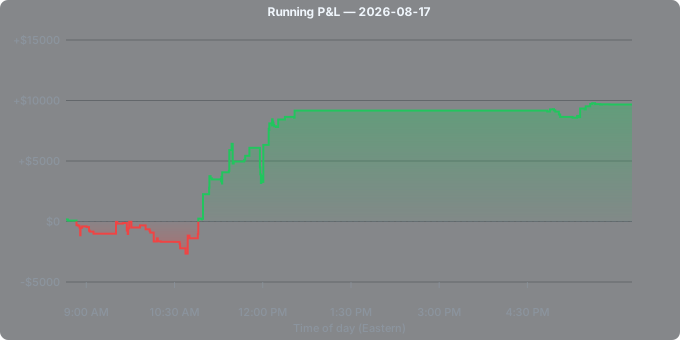
Session edge, AI coach verdict, and running P&L for 2026-08-17.
Trim Review
How much of today's result was carried by a few outliers? The table recomputes the core session stats with the biggest movers removed. Trimmed rows are colored vs baseline: green = holds most of the move, amber = meaningful erosion, red = collapses or flips sign.
| Scenario | Trades | Net P&L | Total R | E[R] / trade | $ WR | PF |
|---|---|---|---|---|---|---|
| Baseline (all trades) | 101 | +$9671.55 | +14.20R | +0.141R | 44.6% | 1.67 |
| − single best + single worst | 99 | +$8244.36 | +12.11R | +0.122R | 44.4% | 1.64 |
| − top 6 + bottom 6 (≈5% each tail) | 89 | +$4738.15 | +6.96R | +0.078R | 43.8% | 1.56 |
Trimmed trades: Single best + single worst — removed WFF +$3057.80 (best) · WFF −$1630.61 (worst). Top 6 + bottom 6 — removed 6 from each tail (by $ P&L).
Broad green session: still clearly green after trimming the biggest movers, so the day was a stack of small plus-EV decisions compounding — not a few home runs.
Session verdict
WFF was the day's engine and the only stock with real depth in your fills: 11 of the 14 material trades were in it, spanning +4.49R at 12:00pm down to -2.39R at 11:29am and -2.38R at 11:57am. There's no open-to-high or highTime data logged for WFF today, but the fact that it halted 6 times tells you this was an extremely volatile, wide-range name — exactly the kind of stock that produces both a $3.06k winner and a $1.63k loser within the same session.
Net, your WFF trading alone likely accounts for the bulk of the day's $9.67k, with the two losing entries (11:29am, 11:57am) coming right in the middle of a stretch that was otherwise your best window of the day (11:00am-11:30am: 13 trades, 61.5% win rate, +$2.53k).
IPST offered a real move — open $7.92 to high $9.66 at 10:59am, +22% — but gave almost all of it back, closing at $7.39 for only -30% retained. You caught the top of that move well: your 10:59am fill (+2.99R, +$2.04k) landed almost exactly at the high print, and your 9:30am entry (+1.44R, +$982) captured the earlier leg.
That's a case of trading a fader correctly by getting out before the fade — you took real money from a stock that gave nearly all its move back to the close. WETO was the outlier: it moved a staggering +322.7% from open to high (open $10.16, high $42.94) across 5 halts, ending the day retaining 44% of that move at $24.59, but your only fill was a -1.08R, -$738 loss at 10:08am — a small scrape against a name that offered one of the largest moves of the entire week.
WFF and IPST were the trades that mattered; WETO and the single XOS long (+$709 at 5:23pm, against a stock that gapped 127.6% intraday but closed flat) were peripheral. Nine other runners this week and today moved 30%+ from their opens that you never touched, including WETO's own 322% swing, so the opportunity cost sits almost entirely in a name you did trade lightly rather than in ones you ignored.
Across the trailing week, the split between holders and bleeders lines up with float and timing more than with move size. WETO (0.7M float, high at 16:47) held 44%; MDXH (81M float) held 38%; FGI (0.5M float, high at 12:37) held 28% — all three had highs after 11am.
By contrast, UCL (38.1M float, high 08:09) retained -91%, IVF (2.5M float, high 07:00) retained -85%, and GLE (8.3M float, high 09:22) retained -130%, all with highs before 9:30am. Six of the eight names with sub-9:30am highs this week gave back more than half their move.
Your two real positions today, WFF (multiple halts, midday action from 9:30am to 12:06pm) and IPST (high at 10:59am, -30% retained), sit closer to the mid-morning fader pattern than the afternoon-holder one — IPST's fade fits the pattern of morning-high names bleeding into the close, and you were positioned to profit from that fade rather than get caught in it.