2026-06-01 · 5 min read
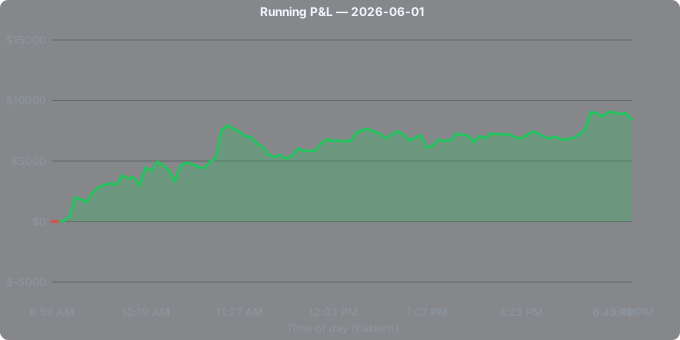
Session edge, AI coach verdict, and running P&L for 2026-06-01.
Trim Review
How much of today's result was carried by a few outliers? The table recomputes the core session stats with the biggest movers removed. Trimmed rows are colored vs baseline: green = holds most of the move, amber = meaningful erosion, red = collapses or flips sign.
| Scenario | Trades | Net P&L | Total R | E[R] / trade | $ WR | PF |
|---|---|---|---|---|---|---|
| Baseline (all trades) | 99 | +$8437.54 | +10.48R | +0.106R | 48.5% | 1.66 |
| − single best + single worst | 97 | +$7150.62 | +8.88R | +0.092R | 48.5% | 1.61 |
| − top 5 + bottom 5 (≈5% each tail) | 89 | +$4018.12 | +4.99R | +0.056R | 48.3% | 1.45 |
Trimmed trades: Single best + single worst — removed HKIT +$2316.78 (best) · JZ −$1029.87 (worst). Top 5 + bottom 5 — removed 5 from each tail (by $ P&L).
Broad green session: still clearly green after trimming the biggest movers, so the day was a stack of small plus-EV decisions compounding — not a few home runs.
Session verdict
The numbers say +$8.44k on 99 positions with 0.106R E[R] and 48.5% WR, while the material-trade list says 7 trades (7.1% of volume) drove almost the entire day. The 5 winners ≥ +1R contributed $8.16k, which is 96.7% of the whole-day P&L, so the remaining 94 positions netted only about +$280 despite consuming almost all of the click count.
HKIT shows 3 winners between +1.65R and +2.88R for $5.10k and 1 loser at -1.13R for -$908.97, so 4 HKIT material trades alone produced roughly 49.7% of the day’s P&L. TGHL at +1.96R for $1.58k and DXST at +1.86R for $1.49k added another $3.07k, meaning just 3 names (HKIT, TGHL, DXST) account for $8.17k, or 96.8% of net.
With 7 material trades generating $8.44k and 92 non-material trades contributing essentially flat P&L, the session was dominated by a handful of high-R setups rather than broad-based small edges. The 34 positions in $1–2 names made only $1.02k and the 10 positions in $0.50–1.00 made $813.04, so 44 low-priced trades added $1.83k while 55 trades above $2 added $6.61k, which shows most of the dollars came from the higher-priced buckets.
Given a day WR of 48.5% on 99 positions against a breakeven WR of 36.1%, you hit well above the 36.1% threshold, but almost all of the payoff still came from 7 trades, not from the other 90+ entries.
Significance and conceptual math
The day’s 0.106R E[R] vs the 0.039R 90-day baseline means you printed about 2.7x your usual per-trade expectancy on 99 positions, so the edge today came from quality of payoff (1.77:1 R:R) rather than an outlier win rate. Win rate at 48.5% (48/99) was only +1.2pp over the 47.3% (1817/3839) baseline, and the z=0.227 with p≈0.8203 says this WR is statistically indistinguishable from your normal, so the session doesn’t show a regime change in hit rate.
With average win $440.40 and average loss -$249.05, breakeven WR is 36.1%, so today’s 48.5% WR bought you a 12.4pp cushion over breakeven. If you held the same 1.77:1 R:R but dropped WR by 5pp to 43.5%, you’d still be above the 36.1% breakeven and likely positive on the day, which implies many of the 99 entries were not needed to get above zero.
The 7 material trades (7.1% of total) produced effectively the entire +$8.44k, so their average contribution was about +1.2R while the other 92 trades averaged near 0R combined. The $2–3 bucket’s 12 trades for $1.95k at 66.7% WR and the $3–5 bucket’s 25 trades for $1.48k at 48.0% WR together made $3.43k on 37 trades, while the $5–10 bucket made $3.17k on 18 trades at 44.4% WR, so those three buckets together generated $6.60k on 55 trades.
The $1–2 and $0.50–1.00 buckets together used 44 trades to generate $1.83k, or about $41.6 per trade, versus about $162.2 per trade in the $2–3 bucket and about $176.1 per trade in $5–10 when you include all P&L in those bands, so lower-priced names were much less efficient in dollar expectancy. Last 7d (excl today) show PF 1.61 on 284 trades versus PF 1.17 on 1364 trades in the prior 30d, so your profit factor has improved even as WR slipped by -0.7pp (44.7% vs 45.5%), and today’s PF 1.66 lines up with that shift toward fatter winners over time.
Since same-session trades are correlated, the z=0.227 contrast is loose, but nothing in the WR or PF data suggests a new hit-rate regime; the standout difference is a higher R:R and a small set of trades carrying most of the result.
What you might have missed
Out of $8.44k total P&L, only about $280 came from all 92 non-material trades combined, so 92.9% of your entries generated just 3.3% of the net dollar outcome. The $2–3 bucket’s 12 trades at 66.7% WR produced $1.95k, which is more per trade than the $3–5 bucket’s $1.48k on 25 trades at 48.0% WR and shows that mid-priced names were highly efficient even without the very largest winners.
The 44 trades in sub-$2 names ($1–2 plus $0.50–1.00) delivered only $1.83k versus $6.61k from 55 trades above $2, which means close to half of your day’s tickets operated in a much lower-yield price zone.
One thing to try next session
Cap yourself at 60 trades tomorrow by pre-allocating a hard maximum of 10 tickets to sub-$2 names and 10 total tickets to any ticker that hasn’t yet produced at least +1R on the day, so you’re forced to concentrate risk in the kinds of setups that generated today’s 7 material trades and limit the 90+ low-R entries that collectively added only about $280.