2026-06-02 · 5 min read
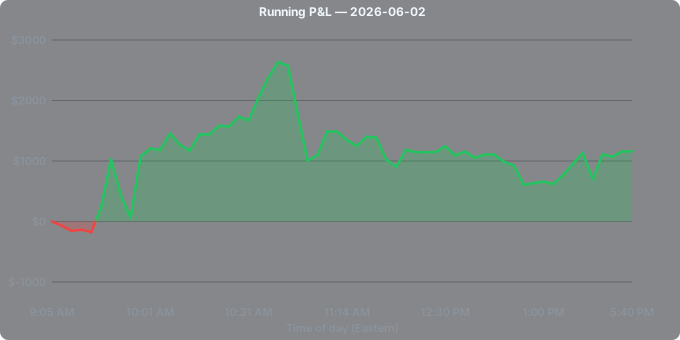
Session edge, AI coach verdict, and running P&L for 2026-06-02.
Trim Review
How much of today's result was carried by a few outliers? The table recomputes the core session stats with the biggest movers removed. Trimmed rows are colored vs baseline: green = holds most of the move, amber = meaningful erosion, red = collapses or flips sign.
| Scenario | Trades | Net P&L | Total R | E[R] / trade | $ WR | PF |
|---|---|---|---|---|---|---|
| Baseline (all trades) | 59 | +$1158.20 | +1.30R | +0.022R | 49.1% | 1.22 |
| − single best + single worst | 57 | +$943.49 | +1.06R | +0.019R | 49.1% | 1.21 |
| − top 3 + bottom 3 (≈5% each tail) | 53 | +$1093.20 | +1.23R | +0.023R | 49.0% | 1.35 |
Trimmed trades: Single best + single worst — removed DXST +$1011.98 (best) · HUBC −$797.28 (worst). Top 3 + bottom 3 — removed 3 from each tail (by $ P&L).
Broad green session: still clearly green after trimming the biggest movers, so the day was a stack of small plus-EV decisions compounding — not a few home runs.
Session verdict
With 59 positions, a 47.5% $ win rate, and profit factor 1.22, this path looks like a grindy, near-breakeven sequence where the final +$1.16k outcome is dominated by one event rather than balanced flow. The single material trade, DXST long at +1.14R for +$1.01k in the $3–5 bucket, accounts for about 87% of the whole-day P&L, so the other 58 trades combined only produced roughly +$150.
If you mentally remove DXST, the remaining 58 trades at 47.5% WR with average win/loss of $228.47 / -$180.65 would feel like a marginal, high-churn session where sizing and edge barely clear the 44.2% breakeven WR. The fact that $3–5 names (n=13, +$1.23k, 53.8% WR) carried more than the entire day while $1–2 (n=11, -$434.37, 36.4% WR) and $0.50–1.00 (n=25, -$166.82, 48.0% WR) collectively lost about -$601 means that, without concentration in that single DXST winner, the cheaper buckets would have left you modestly red despite a headline WR in line with baseline.
Given that there were zero ≥ -1R material losers and only one ≥ +1R winner, the intraday risk profile was shaped more by many small cuts than by any dramatic drawdown, and the realized outcome hinged on pairing that steady sub-1R bleed with one outsized $3–5 name rather than a cluster of large winners.
Significance and conceptual math
Today’s 47.5% $ win rate on 59 positions is essentially identical to your 90-day baseline 47.4% (z=0.008, p≈0.9937), so nothing in the sequence of wins vs losses suggests a different hit-rate regime. With average win $228.47 and average loss -$180.65 giving a 1.26:1 reward:risk and a breakeven WR of 44.2%, today’s 47.5% WR buys you only a 3.3pp cushion, which makes path dependence psychologically heavy because a small local losing streak erases most of your statistical edge.
The day-level E[R] of 0.022R versus your 90-day baseline 0.041R shows that, on a per-trade basis, this particular sequence realized only about half your usual expectancy, consistent with most of the 59 entries contributing very little net. The single DXST +1.14R / +$1.01k trade means 1.7% of today’s positions generated ~87% of the P&L, so in any alternate ordering where DXST comes late, most of the day’s timeline would look like near-flat or slightly negative drift.
Price-bucket math reinforces that: $3–5 names (n=13, +$1.23k) more than explain the whole day, while $1–2 (n=11, -$434.37) and $0.50–1.00 (n=25, -$166.82) together subtract about -$601, so if the cheaper names cluster early in the sequence, your equity curve will start below zero even though the final stat line is green. With only one ≥ +1R material winner and zero ≥ -1R losers, the realized drawdown at any point was driven by stacking many sub-1R losses rather than single spikes, which means shuffling the order would change the depth and duration of those multi-loss pockets but not introduce new large shocks.
Relative to the last 7 days (PF 1.63 on 383 trades) and prior 30 days (PF 1.17 on 1364 trades), today’s PF 1.22 sits closer to the 30-day profile, so this run of 59 trades behaves like a typical baseline day except for the single DXST outlier. If you hypothetically drop DXST, the remaining 58 trades are roughly +$150 with the same 47.5% WR and 1.26:1 payoff, which implies that your realized expectancy from the non-material sequence is far below both the 0.022R session average and the 0.041R 90-day baseline.
What you might have missed
The $3–5 bucket at n=13 and +$1.23k out-earned not just every other price tier but the entire session, while the combined 36 low-priced trades in $0.50–1.00 (n=25, -$166.82) and $1–2 (n=11, -$434.37) erased about half of that edge. That means roughly 22% of today’s tickets produced more than 100% of the P&L, and the other 78% collectively diluted it by about -$70, even though the headline win rate across all 59 trades matched your 90-day baseline almost exactly.
Given there were zero ≥ -1R losers, the -$601 from sub-1R losses in $0.50–2 names is a slow bleed that doesn’t show up as any single dramatic hit but materially flattens the equity curve whenever those names cluster in the sequence.
One thing to try next session
Next session, track realized P&L by price bucket during the day and cap new $0.50–2 entries once that sleeve hits about -$250, while allowing $3–5 names (which went +$1.23k on 13 tickets today) to keep running; this directly targets the -$601 drag from cheaper names without touching the bucket that actually produced the whole-day gain.