2026-05-29 · 6 min read
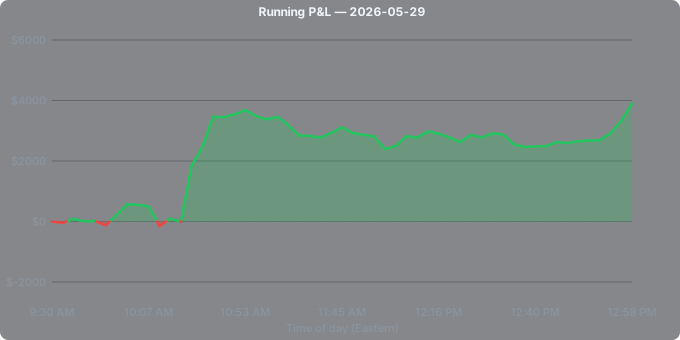
Session edge, AI coach verdict, and running P&L for 2026-05-29.
Trim Review
How much of today's result was carried by a few outliers? The table recomputes the core session stats with the biggest movers removed. Trimmed rows are colored vs baseline: green = holds most of the move, amber = meaningful erosion, red = collapses or flips sign.
| Scenario | Trades | Net P&L | Total R | E[R] / trade | $ WR | PF |
|---|---|---|---|---|---|---|
| Baseline (all trades) | 54 | +$3902.89 | +5.08R | +0.094R | 50.0% | 2.04 |
| − single best + single worst | 52 | +$2702.26 | +3.51R | +0.068R | 50.0% | 1.87 |
| − top 3 + bottom 3 (≈5% each tail) | 48 | +$1843.62 | +2.40R | +0.050R | 50.0% | 1.78 |
Trimmed trades: Single best + single worst — removed NEXR +$1851.61 (best) · HUBC −$650.98 (worst). Top 3 + bottom 3 — removed 3 from each tail (by $ P&L).
Broad green session: still clearly green after trimming the biggest movers, so the day was a stack of small plus-EV decisions compounding — not a few home runs.
Session verdict
From the trade list alone, seeing 54 positions with only 2 material trades ≥1R and no losses worse than −1R, you’d predict a smoothed P&L path with 1–2 decisive inflection points, and the actual +$3.90k day fits that: the +2.41R $1.85k and +1.29R $988.31 NEXR longs in the $2–3 bucket account for $2.84k, or about 72.8% of the session’s net. The $2–3 bucket printed $3.87k on 13 trades with 61.5% WR, so almost the entire day’s profit came from a small cluster where position size and follow-through in that band were high enough to realize R.
In contrast, the 15 trades in $0.50–1.00 generated only $11.17 despite 46.7% WR, and the 11 trades in $0.25–0.50 added $158.30 at 45.5% WR, which means 26 executions contributed just about 4.3% of P&L. Your 50.0% $ WR on the day versus a 32.9% breakeven WR, combined with an average win of $284.17 versus −$139.62 loss, shows that the edge today came from win size relative to loss size more than from an unusually high hit rate.
The absence of any ≤−1R material losers while running 54 positions kept downside variance contained, which is consistent with the profit factor at 2.04 versus the 1.21 baseline. For this trajectory to be sustainable, the pattern of a small subset of $2–3 names producing +1R to +2R moves while the bulk of other buckets net to roughly flat has to repeat frequently enough that these NEXR-type sequences appear at least every few sessions.
That in turn would require that your current mix—2 material winners out of 54 positions, concentrated in the $2–3 bucket while $0.25–1.00 and $0.50–1.00 stay near breakeven—remains typical rather than a one-off configuration.
Significance and conceptual math
Your day E[R] of 0.094R across 54 positions is roughly 2.6x your 90-day baseline E[R] of 0.036R, so in R-terms you compressed about three typical days of expectancy into one session. The $ WR of 50.0% (27/54) is only modestly above the 47.2% baseline, and the z=0.406, p≈0.6844 contrast says the hit rate itself is statistically indistinguishable from your usual, so the improvement came from payoff distribution not accuracy.
With average win $284.17 and average loss −$139.62, your realized reward:risk of 2.04:1 matches the reported profit factor 2.04 closely enough that the day’s PF reflects the average payoff skew rather than a single extreme outlier. Given a breakeven WR of 32.9% from that win/loss profile, your observed 50.0% WR puts you 17.1 percentage points above breakeven, so even a 5pp drop to 45.0% would still leave a positive edge if the 2.04:1 payoff ratio persists.
Last 7 days (excluding today) show PF 1.52 on 323 trades versus PF 1.09 over the prior 30 days on 1457 trades, with a WR dip from 45.9% to 44.0%, which already hints that recent robustness is coming more from payoff skew than from hit rate. Today’s PF 2.04 extends that direction by another step, about 1.34x the last-7d PF and roughly 1.68x the prior-30d PF, so the last ~380 trades plus this session all point to the same structural change: similar or slightly worse WR, meaningfully higher PF.
The net $3.90k on 54 positions compares to a 90-day baseline of $60.73k over 3920 trades, or about $15.50 per trade historically versus about $72.20 per trade today, so you’re running at over 4.6x your long-run dollars-per-trade in this session. Sustainability at that multiple would require that material-trade frequency (2/54 today) and magnitude (2.41R and 1.29R) repeat regularly, because without them the remaining 52 sub-1R trades account for only about $1.06k.
The price-bucket breakdown shows $3.87k of $3.90k coming from $2–3 while $50–100 lost −$61.75 on 3 trades at 33.3% WR and $3–5 leaked −$1.88 on 2 trades at 50.0% WR, so the current edge profile is tightly concentrated in one price regime. If volatility or structure in the $2–3 universe changes such that 2R+ follow-through like NEXR’s +2.41R and +1.29R becomes rarer while the weaker buckets ($0.50–1.00, $50–100, $3–5) stay around flat or negative, then the same hit rate and stop behavior would likely drop your PF back toward the 1.5 zone seen in the last 7 days, or toward the 1.21 baseline if the payoff skew compresses further.
With only 2 material winners driving roughly 72.8% of P&L, a single −2R outlier would have reduced the day’s net by close to half, which quantifies how much the current PF depends on avoiding large losers as you lean on a small number of big winners.
What you might have missed
The 13 trades in the $2–3 price bucket generated $3.87k, which is about 99.2% of the entire $3.90k day, while the other 41 trades across all other buckets combined added only about $31.70. Within that, the two NEXR trades alone at +2.41R $1.85k and +1.29R $988.31 make up about 72.8% of net, so the remaining 52 positions across all tickers and price buckets collectively contributed only roughly $1.06k.
Despite this extreme concentration, you still avoided any material losers ≤−1R across all 54 positions, so the day’s skew came almost entirely from two upside tails in a single $2–3 name rather than from a wide distribution of both big winners and big losers.
One thing to try next session
Next session, predefine a cap such that no more than, for example, 20% of your planned R or trade count can go into the $0.25–0.50, $0.50–1.00, $3–5, and $50–100 buckets combined, while allowing the majority of your risk budget to concentrate in $2–3 names that meet your best A+ criteria (like today’s NEXR). Then track whether this constraint—tilting more deliberately toward the bucket that produced $3.87k today and away from buckets that collectively added only about $31.70—changes your session-level PF and E[R] over the next few days without increasing the frequency of ≥−1R losers.