2026-05-14 · 4 min read
Session edge, AI coach verdict, and running P&L for 2026-05-14.
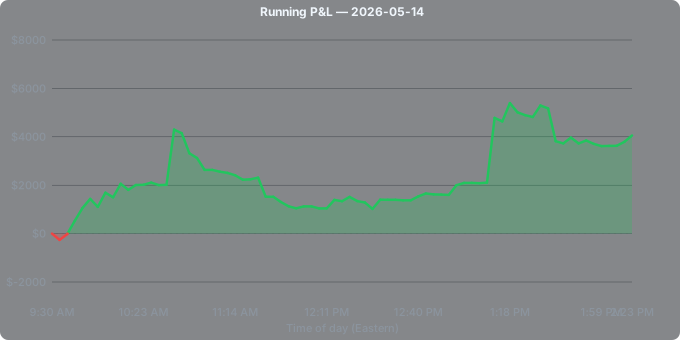
Session slice (heuristic read)
Trim Review
How much of today's result was carried by a few outliers? The table recomputes the core session stats with the biggest movers removed. Trimmed rows are colored vs baseline: green = holds most of the move, amber = meaningful erosion, red = collapses or flips sign.
| Scenario | Trades | Net P&L | Total R | E[R] / trade | $ WR | PF |
|---|---|---|---|---|---|---|
| Baseline (all trades) | 76 | +$4052.11 | +6.95R | +0.091R | 48.7% | 1.51 |
| − single best + single worst | 74 | +$2730.25 | +4.68R | +0.063R | 48.6% | 1.41 |
| − top 4 + bottom 4 (≈5% each tail) | 68 | +$1217.08 | +2.09R | +0.031R | 48.5% | 1.27 |
Trimmed trades: Single best + single worst — removed AIIO +$2675.23 (best) · AIIO −$1353.37 (worst). Top 4 + bottom 4 — removed 4 from each tail (by $ P&L).
Broad green session: still clearly green after trimming the biggest movers, so the day was a stack of small plus-EV decisions compounding — not a few home runs.
Session verdict
Start with the sequence, not the headline P&L: after the 10:32am PT QUCY +3.91R winner, the next meaningful damage came from re-engaging the same leaders in much worse spots. This was not a broad, smoothly earned $4,052 day.
Seven material trades set the tone, and the biggest swings were concentrated in QUCY and AIIO: two outsized winners did most of the lifting, then same-name follow-ups gave back a chunk of it fast. The read itself was real because you got paid when you held 1-10 minutes and let the move work; the weak point was quality decay on re-entry, especially when the prior trade in that ticker had just validated your thesis.
That makes this less a story about market read and more a story about selectivity after first success. Good day, positive expectancy, but the shape was narrow: edge on the initial continuation, sloppier decision quality on later touches.
Significance and conceptual math
The math is favorable, but not forgiving enough to excuse the noise. With average win/loss at $324.60 and -$204.06, breakeven win rate was 38.6%; you printed 48.7%, so the session had a real cushion of about 10 points over breakeven across 76 trades.
Profit factor 1.51 and E[R] 0.091R confirm positive expectancy, but they also say the average trade was only modestly positive, which is why distribution mattered so much. The hold data makes that blunt: <30s trades lost $4,881.71, while 1-2m made $2,878.10, 5-10m made $2,807.46, and the single 3-5m trade made $2,282.18.
So the day was not built by broad fill-by-fill consistency; it was built by a small number of trades that were actually given time to work, while very short-duration attempts acted as a large tax. The 5% accuracy bump adds $2,008.92, but today's bigger lever was not hit rate in general so much as reducing how often sub-30-second attempts interrupted the good holds.
One thing to try next session
Run a very narrow rule next session: after any trade in a ticker that makes 2R or more, block all immediate re-entries in that same name unless it either prints a fresh intraday high after at least one full 5-minute reset or you can state the new trigger and stop before entering. The point is not to trade the symbol less; it's to stop the post-win degradation that showed up in QUCY after 10:32am PT and AIIO after 1:08pm PT.