2026-05-13 · 5 min read
Session edge, AI coach verdict, and running P&L for 2026-05-13.
Session slice (heuristic read)
Trim Review
How much of today's result was carried by a few outliers? The table recomputes the core session stats with the biggest movers removed. Trimmed rows are colored vs baseline: green = holds most of the move, amber = meaningful erosion, red = collapses or flips sign.
| Scenario | Trades | Net P&L | Total R | E[R] / trade | $ WR | PF |
|---|---|---|---|---|---|---|
| Baseline (all trades) | 102 | +$5754.20 | +10.94R | +0.107R | 48.0% | 1.41 |
| − single best + single worst | 100 | +$7276.47 | +13.83R | +0.138R | 48.0% | 1.68 |
| − top 6 + bottom 6 (≈5% each tail) | 90 | +$7151.67 | +13.60R | +0.151R | 47.8% | 2.30 |
Trimmed trades: Single best + single worst — removed WOK +$1635.12 (best) · WOK −$3157.39 (worst). Top 6 + bottom 6 — removed 6 from each tail (by $ P&L).
Broad green session: still clearly green after trimming the biggest movers, so the day was a stack of small plus-EV decisions compounding — not a few home runs.
Session verdict
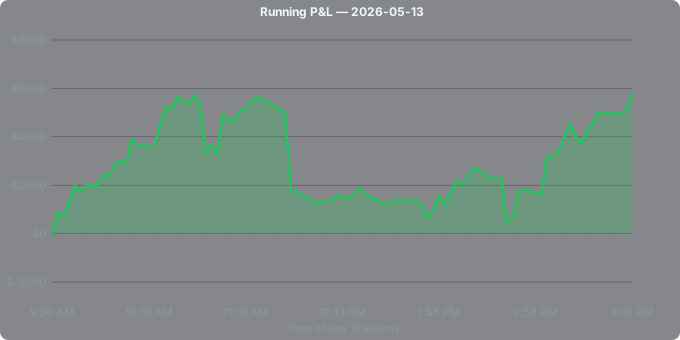
What did the P&L curve feel like to you right after the WOK damage around late morning, and did that feeling change how hard you pushed the afternoon? The short-horizon backdrop is coherent deterioration, not noise: over the last 7 days versus the prior 23, win rate slipped from 46.3% to 43.4% and E[R] from 0.048R to 0.008R, and today breaks that run on outcome even if it doesn’t erase it.
This session was not a broad, steady grind; it was defined by a fat cluster of winners and a few real gut-punch losers, with the 16 trades at or above 1R carrying the whole tape. Emotionally, the path likely felt like a trader getting paid, then getting punched hard, then having to decide whether to force the comeback or keep trading his book.
Net net, you did recover and finish well, so process didn’t fully come off the rails, but two oversized WOK losses plus the later TDIC hit tell me pressure showed up in the tails, not in the day-to-day small stuff. The small quick losses look like business, not a sin; the damage came from staying involved long enough on a few names to let emotion and adverse path dependence matter.
So this day fits inside the recent slump in underlying consistency, but the close says you still had enough control to monetize opportunity instead of spiraling after the punches.
Significance and conceptual math
The bigger evidence is the recent trend, and it’s ugly in a clean, consistent way: 7d versus prior-23d shows net dollars per day down by $1014.95, win rate down 2.9 points, E[R] down 0.041R, and profit factor down 0.18. That’s a coherent deterioration across all four measures, so that’s the real backdrop coming into today.
Today’s session pushed the other way with 0.107R, a 48.0% win rate, and 1.41 PF, so as a one-day print it breaks the short-horizon slide rather than extending it. On the single-day win-rate contrast, 48.0% versus a 45.2% baseline with z = 0.559 and p about 0.576 is basically saying the hit rate itself doesn’t prove today was special; the payoff and trade distribution did the heavy lifting.
The 7d window is only 5 session-days, so don’t read those exact decimals like gospel, but the direction is still clear because every major line item leaned the same wrong way before today. Your payoff math today was solid: with average winners of $401.69 and average losers of $262.81, you only needed 39.5% wins to break even, and you printed 48.0%.
That is real cushion, not a squeaker. The recent 7d window needed 42.9% wins and only delivered 43.4%, which is why that period felt like a grind even when it stayed barely above water.
Said plainly, today had breathing room that the last week mostly did not. And the simple value of improving accuracy by 5 percentage points, holding today’s average win and loss size constant, is $3388.96 for a session of this size.
One thing to try next session
Next session, after any single loss of 3R or worse, enforce a 15-minute reset with no new entries in that same symbol and half-size on the next three trades. That’s not therapy; it’s a circuit breaker for the exact part of today’s equity curve where pressure likely turns normal aggression into tail-risk stupidity.