2026-09-01 · 4 min read
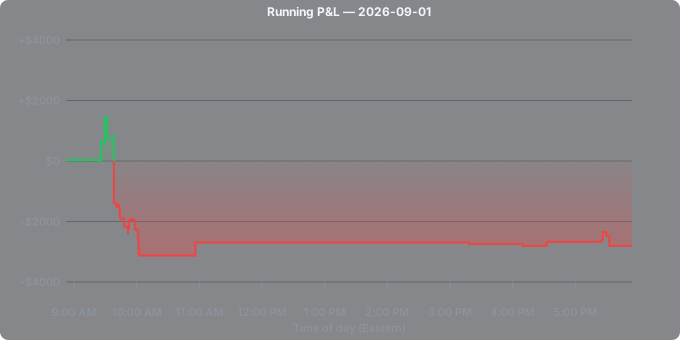
Session edge, AI coach verdict, and running P&L for 2026-09-01.
Trim Review
How much of today's result was carried by a few outliers? The table recomputes the core session stats with the biggest movers removed. Trimmed rows are colored vs baseline: green = holds most of the move, amber = meaningful erosion, red = collapses or flips sign.
| Scenario | Trades | Net P&L | Total R | E[R] / trade | $ WR | PF |
|---|---|---|---|---|---|---|
| Baseline (all trades) | 38 | −$2802.10 | -3.43R | -0.090R | 39.5% | 0.53 |
| − single best + single worst | 36 | −$1440.04 | -1.76R | -0.049R | 38.9% | 0.61 |
| − top 2 + bottom 2 (≈5% each tail) | 34 | −$1381.65 | -1.69R | -0.050R | 38.2% | 0.54 |
Trimmed trades: Single best + single worst — removed BIAF +$864.61 (best) · BIAF −$2226.66 (worst). Top 2 + bottom 2 — removed 2 from each tail (by $ P&L).
Broad-based red session: the loss is still there after trimming the biggest movers — this wasn't one bad trade, it was the whole book tilted the wrong way.
Session verdict
{"dayVerdict":"BIAF was the only stock the trader actually traded today, and it was also the day's biggest single-name loss driver: a 9:29am ET long returned +$864.61 (+1.06R), and a second entry at 9:38am ET, essentially at the day's exact high print of $8.60, lost -$2.23k (-2.72R). Net on the name was roughly -$1.37k, the single largest concentration of today's -$2.80k.
What BIAF actually offered was thin — open $7.72 to high $8.60 is only an 11.4% open-to-high move, one of the smallest openToHighPct figures in today's entire runner list, and it gave almost none of that back cleanly: it closed at $6.59, below the open, for a pctOfMoveRetained of -128%, meaning sellers took the stock well under where it started. This was a low-quality, thin move traded at the worst possible moment relative to its own high, not a case of a big mover being poorly captured.
Zooming out to the day level, today's runner list actually had real moves available elsewhere: FLYE opened at 1.80 and hit 3.97 (120.6% open-to-high) at 5:38am, RDAC ran from 4.90 to 8.58 (75.1%) by 11:11am and held 42% of it into the close, and SSM moved 33.1% with a high at 3:53pm that held 81% into the close — a genuine afternoon holder. None of these were traded.
Across the other 37 fills the trader also touched positions with no name identified as material in either direction (the R-tagged list shows only these two BIAF trades clearing the 1R threshold), so the rest of the day was small-decision noise layered on top of one bad concentration in a stock that simply didn't move enough to justify the size of the loss taken in it. Two other runners today moved 30%+ from the open (RDAC and FLYE) and neither was traded — a modest opportunity cost next to the BIAF loss itself.
Across the trailing week, the pattern separating holders from bleeders is fairly stark on timing and float. Runners whose high printed in the morning session tended to bleed hard into the close — WETO on 8/31 hit its high at 10:58am and closed retaining -25% of the move, RITR's 8:58am high retained -35%, LIDR's 8:39am high retained -45%, and today's own WETO high at 9:34am gave back to -231% retained.
By contrast, moves whose high came later in the day fared better: SSM's 3:53pm high held 81%, JEM's 11:56am high on 8/25 held 46%, CELU's 11:04am high on 8/27 held 69%. BIAF's high at 9:38am ET — the exact minute of the trader's losing entry — sits squarely in the morning-fade cohort that has repeatedly bled in this data, and the trader was on the wrong side of that pattern at the worst possible timestamp.
There is no time-of-day win/loss pattern here that clears a real evidentiary bar across days — the 10:30-11:00am window shows green 6 of 6 days over the last 7 (+$1.76k) and 13 of 18 over 20 days (+$7.61k), which is suggestive but the trader only had a single fill in that window today ($434.67, unrelated to BIAF), so it isn't the story of this session. The story of this session is one concentrated position in a stock whose actual move was small and whose high arrived in the same morning window where this week's data shows repeated fading, combined with 37 other fills that netted out to noise around that core loss."}