2026-07-21 · 4 min read
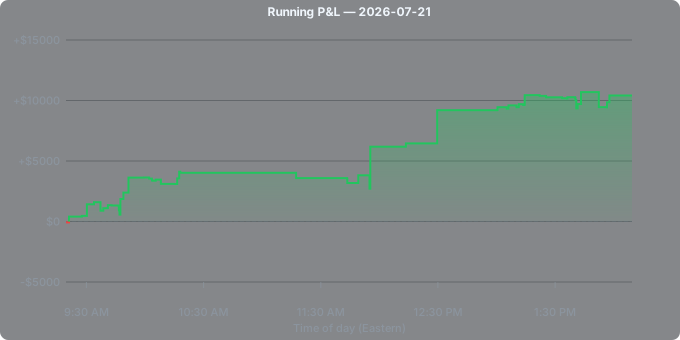
Session edge, AI coach verdict, and running P&L for 2026-07-21.
Trim Review
How much of today's result was carried by a few outliers? The table recomputes the core session stats with the biggest movers removed. Trimmed rows are colored vs baseline: green = holds most of the move, amber = meaningful erosion, red = collapses or flips sign.
| Scenario | Trades | Net P&L | Total R | E[R] / trade | $ WR | PF |
|---|---|---|---|---|---|---|
| Baseline (all trades) | 61 | +$10410.69 | +18.36R | +0.301R | 50.0% | 2.48 |
| − single best + single worst | 59 | +$8180.15 | +14.43R | +0.245R | 50.0% | 2.41 |
| − top 4 + bottom 4 (≈5% each tail) | 53 | +$5396.52 | +9.52R | +0.180R | 50.0% | 2.64 |
Trimmed trades: Single best + single worst — removed CPHI +$3471.92 (best) · OMH −$1241.38 (worst). Top 4 + bottom 4 — removed 4 from each tail (by $ P&L).
Broad green session: still clearly green after trimming the biggest movers, so the day was a stack of small plus-EV decisions compounding — not a few home runs.
Session verdict
{"dayVerdict":"Today's book concentrated in CPHI, and the fills line up well with what the stock actually did — four wins and one loss across eight material trades in that name, netting roughly $8.6k with entries spanning 11:49am to 1:52pm ET. CPHI carries no open/high/close print today, but 4 halts and $345.7M in dollar volume on a 55.6M-share day (against a 27.9M float) confirm this was an extremely volatile session for the stock, and the trader was positioned through the volatility rather than around it — the 11:54am loss of -$1.11k sitting right next to the 11:55am +$3.47k winner suggests they were working the same halt-driven swing from both sides and came out well ahead.
That CPHI pattern also matches its July 15 session in this data set, where it moved +168.3% open-to-high and held 50% of that into the close on 3 halts — a name that has now shown twice in the last week that its halts translate into real retained range, and the trader captured a good share of that both times.
VIVK was the other real contributor, with three material fills netting about +$1.49k against a stock that offered a huge open-to-high move — 102.3% by 10:05am ET on a 0.7M float and $753.3M in dollar volume — but gave essentially all of it back, closing down 1.1% from the open (pctOfMoveRetained -1%). The trader's own VIVK trades were mixed (two wins, one loss), meaning they were extracting value from the volatility itself rather than from a move that held, which is a different and harder skill than riding a holder.
OMH was the day's clear miss: two losses totaling -$1.93k with no material win to offset them, and OMH doesn't appear in today's runner list at all, meaning that loss came from a stock that wasn't moving the way the day's real runners were.
At the day level, this was a case of trading heavily where the volatility actually was — CPHI and VIVK together account for essentially all the material P&L, and both were among the more extreme movers in today's data (VIVK's 102.3% intraday range was the largest of the day). ZYBT also appears once at +$1.29k on a 9:47am ET fill; today's ZYBT print shows no open/high/close data, so its quality can't be sized beyond that single fill.
Several other tickers moved sharply today — SLGB (+69.6% open-to-high), KIDZ (+33.1%), JUNS (+22.5%) — but none were traded, and all three gave back most or all of their move by the close (pctOfMoveRetained of -13%, -143%, and -103% respectively), so the opportunity cost from skipping them looks small; the trader's attention went to the names that mattered more.
Across the last week, the retention pattern is stark: BXBL, BIYA, SDOT (7/20), RUBI, UBXG, ERNA, VIVS, TGHL (7/15), VMAR, NXTC, PMI, BJDX, and SHPH all bled the bulk of their move — 11 of these 13 names closed holding less than a third of their open-to-high range, several going deeply negative (BIYA -202%, UBXG -152%, KIDZ -143% today). The names that held better — STAK (+64% retained), ATPC (+53%), TGHL on 7/16 (+57%), CPHI on 7/15 (+50%) — cluster around afternoon highs made between 12:00pm and 1:00pm ET rather than the pre-market or early-morning spikes that dominate the bleeders' highTimeET values (04:00-09:50 for most of the fade list).
CPHI's own highs today came alongside its 4 halts in the same early-afternoon window the holders favor, and the trader's CPHI entries (11:49am-1:52pm ET) sat squarely inside that window, consistent with trading the stock at the part of its range that has actually tended to hold.