2026-06-11 · 6 min read
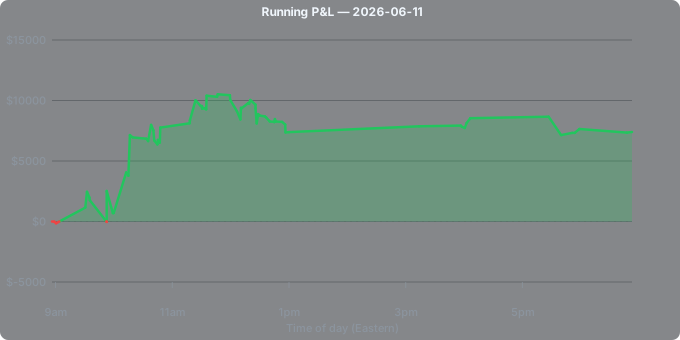
Session edge, AI coach verdict, and running P&L for 2026-06-11.
Trim Review
How much of today's result was carried by a few outliers? The table recomputes the core session stats with the biggest movers removed. Trimmed rows are colored vs baseline: green = holds most of the move, amber = meaningful erosion, red = collapses or flips sign.
| Scenario | Trades | Net P&L | Total R | E[R] / trade | $ WR | PF |
|---|---|---|---|---|---|---|
| Baseline (all trades) | 74 | +$7400.22 | +4.77R | +0.064R | 41.9% | 1.47 |
| − single best + single worst | 72 | +$5868.79 | +3.78R | +0.052R | 41.7% | 1.42 |
| − top 4 + bottom 4 (≈5% each tail) | 66 | +$2863.36 | +1.84R | +0.028R | 40.9% | 1.30 |
Trimmed trades: Single best + single worst — removed PPCB +$3362.13 (best) · PPCB −$1830.70 (worst). Top 4 + bottom 4 — removed 4 from each tail (by $ P&L).
Broad green session: still clearly green after trimming the biggest movers, so the day was a stack of small plus-EV decisions compounding — not a few home runs.
Session verdict
The 7:03am PT EDHL long at $10–15 and the 7:15am PT PPCB long at $5–10 both printed just over +2R for $3.34k and $3.36k, while the 8:23am PT GELS long at $1–2 printed +1.07R for $1.66k; that pattern lines up with you keeping a similar dollar-per-R size across tickers rather than cutting size just because GELS was cheaper. The three PPCB trades between 6:38am and 7:15am PT all used very similar per-R notional sizing (−$1.83k at −1.18R, +$2.55k at +1.64R, +$3.36k at +2.16R), which is consistent with a stable base stake in R terms rather than big discretionary swings in ticket size.
Across the six material trades, the dollar per R clusters around roughly the mid–$1k range (e.g., −$1.80k at −1.16R, +$3.34k at +2.15R, +$1.66k at +1.07R), reinforcing that you mapped R to dollars consistently instead of changing it by ticker or time. With 74 positions generating $7.40k and E[R] of 0.064R, the implied average dollar edge per trade is in the low-$100s, while the six material trades average about $1.2k net each, so most of the day’s performance came from that small set where size and follow-through both showed up.
The 7:00am–7:30am PT window at n=4 and $6.25k P&L produced the majority of the day’s result, and its two material wins (EDHL +$3.34k, PPCB +$3.36k) account for essentially that entire window, so what you did in those early, sized trades mattered far more than anything later. In contrast, the 7:30am–8:00am PT window had 11 trades, a 27.3% WR, yet still netted +$811.69, which implies the losers there stayed near the −$368.82 average loss or smaller, allowing the early gains to stand.
The $10–15 bucket is just 1 trade for +$3.34k and the $5–10 bucket is 18 trades for +$5.24k, while the $1–2 bucket is 24 trades for +$2.53k, so each mid-priced conviction ticket produced far more P&L than the average low-priced ticket.
Significance and conceptual math
Breakeven win rate from today’s $750.30 / −$368.82 avg win/loss is 33.0%, and you came in at a 41.9% $ WR, so your payoff skew bought you roughly 9pp of cushion above break-even. With an E[R] of 0.064R over 74 positions, that’s about 4.7R of edge for the session, and the six material trades alone add up to roughly +4.7R, so the statistical edge is effectively entirely in that subset.
In dollar terms, those six material trades produced a combined net of about +$7.28k versus the total +$7.40k P&L, which means the remaining 68 trades netted only around +$120. The baseline E[R] is 0.059R over 3759 trades, so today’s 0.064R is only slightly above your 90-day norm, and the outsized P&L comes from how that edge was concentrated in a few large-R outcomes rather than from a different average R per trade.
Day WR at 41.9% vs the 47.4% baseline (z = −0.932, p ≈ 0.3514) is statistically indistinguishable from your usual hit rate, pointing to the $750.30 / −$368.82 skew and stable R-dollar mapping as the main drivers of the $7.40k. The last 7 days (excl today) show WR 50.4% and PF 1.73 vs prior-30d WR 45.4% and PF 1.29, and today’s PF of 1.47 lands between those, numerically closer to the improved 7d regime than the older 30d regime.
The $5–10 bucket at n=18 and +$5.24k plus the lone $10–15 EDHL trade at +$3.34k sum to $8.58k, so 19 trades in the $5–15 range more than covered the whole day before the $15–20 bucket (−$642.59) and $3–5 bucket (−$390.25) pulled the net back to $7.40k. The two large losers, EDHL at 6:36am PT (−1.16R, −$1.80k, $15–20) and PPCB at 6:57am PT (−1.18R, −$1.83k, $5–10), total −$3.63k, which sits in line with the same per-R risk that produced the four winners, showing that the downside per trade was tightly controlled relative to the upside.
Because the $1–2 bucket needed 24 trades to generate $2.53k (about $100 per ticket), while the single $10–15 EDHL win generated $3.34k alone, the math favors concentrating risk in a few $5–15 names over taking many small stabs in sub-$3 names.
What you might have missed
The entire $7.40k day essentially collapses to the six material trades’ $7.28k net, with the other 68 positions collectively adding only around $120 despite being 91.9% of the trade count. Within that, the 7:03am PT EDHL long at $10–15 and the 7:15am PT PPCB long at $5–10 together generated about $6.70k, which is over 90% of total P&L, so nearly every other trade just tweaked the final number around those two decisions.
At the same time, your two largest losers (−$1.80k and −$1.83k at −1.16R and −1.18R) sit in a very narrow R band relative to the winners’ R multiples, showing that you allowed full-R moves in both directions without letting any single loser blow out beyond plan.
One thing to try next session
For the next session, explicitly cap total allocated risk in sub-$3 names to 1R per ticker (e.g., GELS-style $1–2 plays) and reallocate that freed risk to at most two $5–15 names that look closest to today’s EDHL and PPCB in your prep, using the same dollar-per-R size as this session. After the close, compare how much P&L those 2–3 mid-priced, higher-conviction tickets generate versus the entire low-priced bucket under this cap.