2026-04-17 · 6 min read
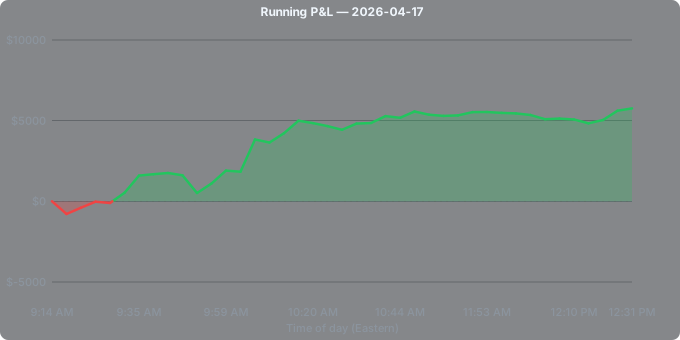
Session edge, AI coach verdict, and running P&L for 2026-04-17.
Session slice (heuristic read)
Trim Review
How much of today's result was carried by a few outliers? The table recomputes the core session stats with the biggest movers removed. Trimmed rows are colored vs baseline: green = holds most of the move, amber = meaningful erosion, red = collapses or flips sign.
| Scenario | Trades | Net P&L | Total R | E[R] / trade | $ WR | PF |
|---|---|---|---|---|---|---|
| Baseline (all trades) | 40 | +$5761.56 | +12.72R | +0.318R | 55.0% | 2.43 |
| − single best + single worst | 38 | +$4864.64 | +10.74R | +0.283R | 55.3% | 2.66 |
| − top 2 + bottom 2 (≈5% each tail) | 36 | +$4578.12 | +10.11R | +0.281R | 55.6% | 3.13 |
Trimmed trades: Single best + single worst — removed EFOI +$1997.18 (best) · EFOI −$1100.26 (worst). Top 2 + bottom 2 — removed 2 from each tail (by $ P&L).
Broad green session: still clearly green after trimming the biggest movers, so the day was a stack of small plus-EV decisions compounding — not a few home runs.
Session verdict
What surprised me most is that this looks like a conviction day that was mostly sized in the right places, not a spray-and-pray green day. The short-horizon backdrop is already in coherent improvement, with 7d versus prior-23d showing win rate up from 45.2% to 48.9% and E[R] up by 0.064R, and today clearly extends that trend rather than merely fitting inside it.
Session geometry was favorable but not dependent on a single miracle print: the 10 trades at or above 1R were shaped 8 winners against 2 losers, with only two trades above +2R, so the curve was supported by multiple meaningful gains rather than one bailout. From a sizing lens, the dispersion says you were willing to press when opportunity quality was high, and the fact that the largest win was +4.41R while the two material losses were contained to -2.43R and -1.73R argues for aggressive participation without loss of containment.
The path still had some whipsaw in it, especially around the EFOI cluster, but it reads more like selective pressure than emotional overreach. The main process risk is not oversizing the bad stuff; it is whether you are still giving too many low-conviction probes standard size before the market proves it deserves your bigger bullets.
Significance and conceptual math
The stronger evidence is the recent trend, not the one-day headline. Over the last 7 days versus the prior 23, net P&L per session-day improved by $1985.22, win rate improved by 3.7 percentage points, E[R] improved by 0.064R, and profit factor improved by 0.31, which is why the pack calls it coherent improvement.
Today lines up with that broader shift: 0.318R for the session is well above the 7d average of 0.089R, and profit factor at 2.43 is also stronger than the 7d mark of 1.45, so this session looks like an extension of a better recent operating state. The single-day z of 1.178 with p about 0.2389 is only a quick sniff test, and it does not prove today’s 55.0% win rate was truly different from your baseline 45.7%.
More importantly, your fills today were not isolated little events; same morning, same symbol, similar conditions means wins and losses can bunch, so that z/p is less trustworthy than the headline makes it look. Sample-wise, the 7d window is only 5 active session-days, so call the trend real but still young.
The breakeven math is the useful anchor: with average winners of $445.37 and average losers of -$224.25, you only needed 33.5% wins to stay above water today, and you printed 55.0%, which is a wide margin of safety. The 7d window tells a similar story: breakeven there was 39.7% and realized win rate was 48.9%, so the recent edge is coming from both decent hit rate and favorable payoff ratio, not from needing hero accuracy.
The rough what-if from the pack says that a 5 percentage-point lift in win rate, holding average win and loss size constant, would have added about $1339.25 today; that is not a forecast, just a reminder that small improvements in selectivity compound fast when your payoff ratio is already near 2:1. The practical read is that sizing discipline matters more than chasing a few extra winners, because once your winners are materially larger than your losers, better conviction allocation has more leverage than raw activity.
What you might have missed
The non-obvious part is that your biggest winner being nearly twice the size of your biggest loser is less interesting than the fact that the day still worked without relying on it. Even after removing the +4.41R outlier mentally, the material-trade shape remains healthy, which suggests your sizing was attached to a repeatable read rather than one emotional all-in moment.
One thing to try next session
For the next session, use a two-tier size rule on the same symbol: first entry at base size, and only allow add-on or larger second entry after one trade in that name has already paid at least +1R or shown clean follow-through. That turns conviction into something earned intraday, which should keep standard-size money away from low-information probes while still letting you press hard when the tape proves you right.