2026-04-16 · 6 min read
Session edge, AI coach verdict, and running P&L for 2026-04-16.
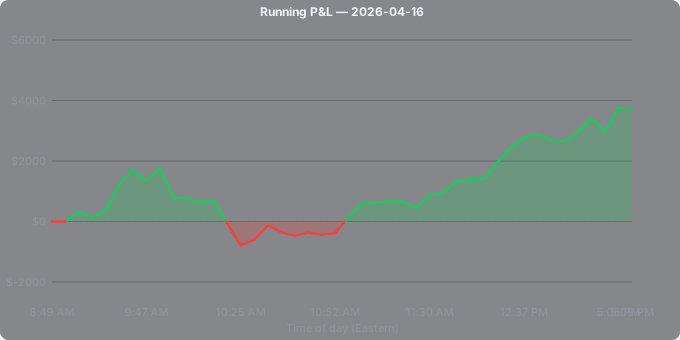
Session slice (heuristic read)
Trim Review
How much of today's result was carried by a few outliers? The table recomputes the core session stats with the biggest movers removed. Trimmed rows are colored vs baseline: green = holds most of the move, amber = meaningful erosion, red = collapses or flips sign.
| Scenario | Trades | Net P&L | Total R | E[R] / trade | $ WR | PF |
|---|---|---|---|---|---|---|
| Baseline (all trades) | 43 | +$3723.46 | +8.95R | +0.208R | 60.5% | 1.82 |
| − single best + single worst | 41 | +$3860.61 | +9.28R | +0.226R | 61.0% | 2.08 |
| − top 3 + bottom 3 (≈5% each tail) | 37 | +$4043.31 | +9.72R | +0.263R | 62.2% | 2.97 |
Trimmed trades: Single best + single worst — removed ONFO +$844.51 (best) · BTOG −$981.66 (worst). Top 3 + bottom 3 — removed 3 from each tail (by $ P&L).
Broad green session: still clearly green after trimming the biggest movers, so the day was a stack of small plus-EV decisions compounding — not a few home runs.
Session verdict
What told you a setup deserved real size today instead of just standard participation? The short-horizon backdrop is still a coherent improvement: over the last 7 days versus the prior 23, E[R] improved from 0.037R to 0.061R, profit factor rose from 1.23 to 1.34, and net per session-day lifted by $1159.11, so today extends that trend rather than breaking it.
This was not a one-lottery-ticket session; the shape was broad enough to matter, with the 14 trades at or above 1R split 10 winners and 4 losers, but the tails still mattered because two losses near -2R consumed a lot of room. On sizing and conviction, the book looks only partly aligned with edge: you had a single +2R winner, but your largest dollar outcomes were not cleanly concentrated in the best-executed holds, which suggests some size was still spread into lower-certainty swings rather than reserved for the cleanest tape.
The path feels tradable rather than chaotic because the day stayed green despite those outsized hits, but there was still a forcing tail around the late-morning cluster where the same names produced both your biggest giveback and some of your best wins. Net-net, this reads more like decent process with imperfect size discrimination than pure luck or a major lapse.
Significance and conceptual math
The main evidence is the recent trend, not the single session headline. Your last 7 days versus the prior 23 show coherent improvement: net per session-day is up by $1159.11, E[R] per fill is up by 0.024R, profit factor is up by 0.12, and $ win rate is basically flat at 45.7% versus 46.2%, which means the improvement is coming from better payoff quality more than from simply being right more often.
Today fits that pattern almost perfectly: you printed 0.208R on the day with a 1.82 profit factor, and you only needed a 45.7% win rate to break even given your average winner and loser size, while you actually hit 60.5%. In plain English, the edge today came from both clearing your required hit rate and keeping the win/loss payout ratio favorable enough that misses did not dominate.
The single-day z of 1.964 with p about 0.0496 is a quick sniff test saying today’s 60.5% win rate was better than your long baseline 45.4%, but that number is flimsier than it looks because the same morning, same names, and similar setups make wins and losses bunch together. So I would treat the z/p as consistent with the broader 7-day improvement, not as proof by itself that skill suddenly jumped today.
Sample size is still modest on the 7-day window because it covers only 5 session-days, so call the trend real but short-horizon, not permanent. The breakeven comparison is the important practical check: over the last 7 days you needed 38.5% wins and achieved 45.7%, and today you needed 45.7% and achieved 60.5%, so both the recent run and today are operating with cushion, not scraping by.
That cushion matters because it means sizing mistakes, not entry accuracy alone, are now the bigger threat to keeping the trend intact. The pack’s 5-point win-rate toy says that with today’s average winner, average loser, and 43 fills, a rough extra 5 percentage points of accuracy would have been worth about $1257.63; that is a what-if, not a forecast, but it shows small changes in selectivity are now monetarily meaningful.
The caution is simple: when outcomes bunch inside a few names and a few bursts of activity, it is easy to over-credit conviction when some of the day is really local momentum plus repeated exposure.
What you might have missed
The most non-obvious part of the session is that your sizing problem was not that losers were universally oversized; it was that dollar dispersion was too similar across very different-quality outcomes. A few of the biggest losses sat in the same dollar neighborhood as several of the better winners, which means conviction was not being expressed selectively enough even though the day finished strong.
That is usually a sign of flat default sizing with occasional hold-time drift, not truly ranking setups by expected edge.
One thing to try next session
For the next session, pre-label each entry A or B before sending the order and allow full size only on A setups; cap B setups at half size and do not add to them after entry. Review only the trades above about $450 absolute P&L afterward and ask one question: did those larger bets come from pre-declared A setups or from in-the-moment excitement?