2026-10-12 · 5 min read
Session edge, AI coach verdict, and running P&L for 2026-10-12.
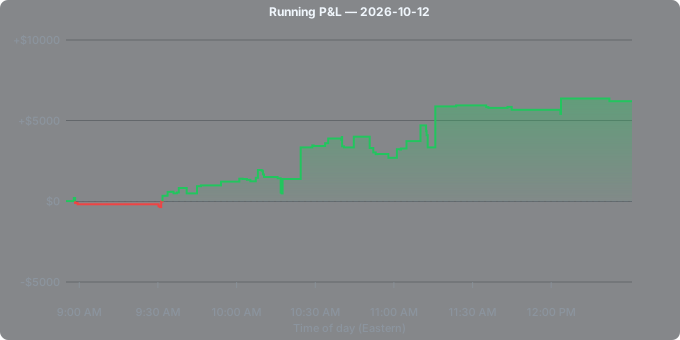
Trim Review
How much of today's result was carried by a few outliers? The table recomputes the core session stats with the biggest movers removed. Trimmed rows are colored vs baseline: green = holds most of the move, amber = meaningful erosion, red = collapses or flips sign.
| Scenario | Trades | Net P&L | Total R | E[R] / trade | $ WR | PF |
|---|---|---|---|---|---|---|
| Baseline (all trades) | 66 | +$6209.57 | +6.66R | +0.101R | 48.5% | 1.91 |
| − single best + single worst | 64 | +$4561.05 | +4.89R | +0.076R | 48.4% | 1.77 |
| − top 4 + bottom 4 (≈5% each tail) | 58 | +$2691.83 | +2.89R | +0.050R | 48.3% | 1.69 |
Trimmed trades: Single best + single worst — removed MNDR +$2538.67 (best) · WFF −$890.14 (worst). Top 4 + bottom 4 — removed 4 from each tail (by $ P&L).
Broad green session: still clearly green after trimming the biggest movers, so the day was a stack of small plus-EV decisions compounding — not a few home runs.
Session verdict
MNDR is where the day lived. The stock opened at $2.59 and ran to a high of $5.67 by 11:16am, a 118.9% move that gave back almost all of it by the close at $3.04 (only 15% of the open-to-high move held).
You took 36 positions in it between 9:30am and 11:44am, 34 of them before the 11:16am high, and extracted +$8.84k gross against that move — the single largest print being +$2.54k at 11:15am, entered within a minute of the eventual top. That is a real share of a real move, taken with volume (21 wins against 15 losses) rather than one lucky entry.
WFF offered the largest move of any runner today by a wide margin — open $14.75 to a high of $50.60 at 2:47pm, +243.1%, before collapsing to $17.28 (just 7% of the move retained) — and it also carried 41 halts, the most activity of anything you touched. You were in it early and often: 12 positions from 8:54am, all entered before the 2:47pm high, netting -$836.
Your biggest single loss of the day, -$890, came at 10:16am, well before the eventual top, while your best WFF print, +$957, came at 12:03pm on a 20-second hold. A stock that moved 243% from the open cost you money net — the halts gave you the range, but the exits around them didn't convert it into dollars the way MNDR did.
YMAT and NCPL were smaller, faster, and went the other way. YMAT ran 72% to a $4.49 high at 10:50am and gave back 84% of that by the close ($2.91); your 10 entries between 10:39am and 10:57am split 3 wins/7 losses for -$1.20k, with 5 of 10 entries coming after the high was already in.
NCPL moved 78.5% to $2.66 at 11:33am and kept only 4% of it; both your entries came at 11:35-11:36am, after the top, for -$154. IPW moved 47.4% to its high at 8:57am and then fell clean through the open to close down 29%; all three of your entries came after the 8:57am high, for -$196.
CLWT and ELOG were minor: CLWT's real high was premarket at 7:30am (+46.6%) and it held only 17% into the close, while your two 9:34-9:35am entries were chasing a stock already well off its top, for -$87; ELOG's high came at 12:16pm (+47.6%, holding 49%) and your single 12:22pm entry, right at a halt, lost $166.
Of the two runners you skipped today, both moved 30%+ from the open (two of 50%+, the largest +172.7%), and neither held even half the move into the close — in line with how most of today's movers behaved, so the opportunity cost of sitting those out looks limited next to what MNDR alone returned.
Across the trailing week, holding behavior splits sharply by when the high landed and how violent the halt activity was: stocks whose highs came in the premarket or very early morning (4:00-8:30am) mostly gave back the whole move — several closed at -100% retained — while names with halts clustering through the late morning and afternoon, like WFF's 41 and the 6-10 halt names from prior sessions, more often kept something into the close. MNDR's 2 halts (10:19am, 11:36am) and 11:16am high put it in the better-retention group even though it still surrendered 85% of its move; WFF, despite the heaviest halt count of the week, only kept 7%.
Your own book fits the split: the one name you traded heavily and profitably, MNDR, was also the one with the earlier, cleaner high and lighter halt count, while WFF's extreme halt activity didn't translate into retained value for you or the stock.
Your playbook data shows the lane structure mattered more than the ticker. The two trades flagged A+ — 2+ halts before entry held 30 seconds or longer — were the WFF entries at 10:16am (-$890) and 11:12am (-$755), both of which lost money today despite sitting in your best validated lane (+11.0 per $1k historically).
The DONT lane, 2+ halts before entry scalped under 30 seconds, held 10 positions for -$812 today, consistent with its -3.3 per $1k historical tier. Overall, the 16 positions with 2+ halts before entry cost you -$2.90k, while the 50 positions with fewer than 2 halts before entry made +$9.10k — on this particular day, the halt-heavy names worked against the historical edge rather than with it.