2026-08-07 · 5 min read
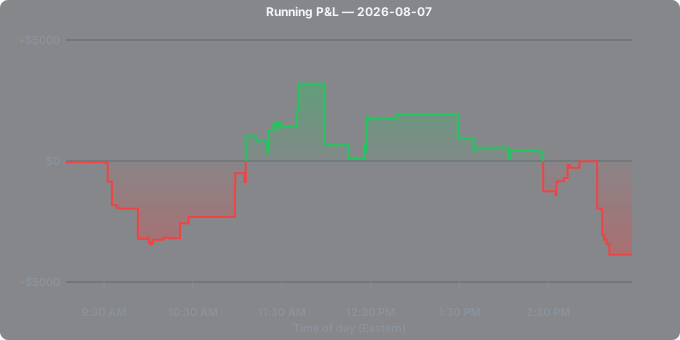
Session edge, AI coach verdict, and running P&L for 2026-08-07.
Trim Review
How much of today's result was carried by a few outliers? The table recomputes the core session stats with the biggest movers removed. Trimmed rows are colored vs baseline: green = holds most of the move, amber = meaningful erosion, red = collapses or flips sign.
| Scenario | Trades | Net P&L | Total R | E[R] / trade | $ WR | PF |
|---|---|---|---|---|---|---|
| Baseline (all trades) | 70 | −$3872.95 | -5.41R | -0.077R | 42.9% | 0.76 |
| − single best + single worst | 68 | −$3838.05 | -5.36R | -0.079R | 42.6% | 0.73 |
| − top 4 + bottom 4 (≈5% each tail) | 62 | −$3587.38 | -5.01R | -0.081R | 41.9% | 0.65 |
Trimmed trades: Single best + single worst — removed YJ +$1915.30 (best) · WFF −$1950.21 (worst). Top 4 + bottom 4 — removed 4 from each tail (by $ P&L).
Broad-based red session: the loss is still there after trimming the biggest movers — this wasn't one bad trade, it was the whole book tilted the wrong way.
Session verdict
{"dayVerdict":"YJ was the trader's main event and, on the data provided, a stock with no printed open, high, or close-retention figures — only a gap of +12.2% and a close near $3.49. Despite the missing move data, YJ generated five material fills between 10:58am and 12:27pm ET: three winners (+$1.38k, +$1.92k, +$1.08k) and two losses on what looks like the same re-entry near 11:58am (-$1.47k and -$1.07k), netting out to roughly +$1.86k on the name.
That's a real positive share extracted from a stock that was clearly moving enough to halt twice, even without a clean open-to-high number to size the opportunity against.
WFF was the other story, and it was the session's most violent mover — open $2.53 to a high of $10.53 at 2:21pm ET, a 316% open-to-high swing that gave back two-thirds of itself, closing at $5.19 for 33% retention after nine halts. The trader took three material losses in it: -$1.95k at 3:03pm, -$1.42k at 2:26pm, and -$1.05k at 3:06pm, all after the 2:21pm high — meaning every material WFF fill came on the wrong side of the reversal, for a combined -$4.42k.
That single name is responsible for more than the entire day's net loss. NAMI added another -$3.0k across three fills between 9:32am and 9:52am, in a stock that ultimately fell 424% of its open-to-high move by the close (open $9.11, high $10.23 at 8:44am, close $4.36) — a stock that bled almost the entire session, and one where the early fills were already fighting a losing trend before the worst of the collapse.
HUIZ contributed one further loss of -$990 at 1:29pm. Against all this, YJ's net gain of roughly +$1.86k was the only real bright spot; the day closed -$3.87k on 70 positions, a day where the two names offering genuine, sustained ranges (WFF's 316% swing, NAMI's round trip) were the ones that produced almost all of the damage, while the one name with real edge captured could only cover a fraction of it.
Sizing the missed opportunity: several other names moved well beyond anything the trader touched — WFF itself aside, MB moved 38% from open to high before giving it all back and closing down 38% from open (101% of the move erased), and VSA ran 163% intraday while holding just 12% of it into the close. Neither was traded, and the trader's realized exposure was concentrated in only four tickers (YJ, WFF, NAMI, HUIZ) out of fourteen runners logged for the day — a day where the opportunity set was broader than what got worked.
Looking across the last week, the clearest split is by float and hold time: DFNS (Aug 3) retained 68% of a 69% open-to-high move with a 2:11pm high and just 0.9M float; AMIX (Aug 4) held 73% of a 359% move with a 3:44pm high; YXT (Aug 5) held 65% of a 339% move with a 3:21pm high. All three of those top-retention runners made their highs after 1pm.
By contrast, NAMI's own prior-day print (Aug 6) made its high at 6:13pm and kept only 3% of a 161% move, and the Aug 7 NAMI made its high at 8:44am and kept -424% — both premarket-to-morning highs faded hard. WFF's high today came at 2:21pm, later than the fading NAMI and closer to the DFNS/AMIX profile, yet it still only held 33%, showing the afternoon-high pattern isn't automatic protection once halts and reversal violence get extreme enough.
The trader's two loss-heavy names this session, WFF and NAMI, both sit on the fade side of that split — NAMI twice now, in two different sessions, with a premarket or pre-10am high both times, exactly the profile that has bled hardest in this data set."}