2026-07-09 · 5 min read
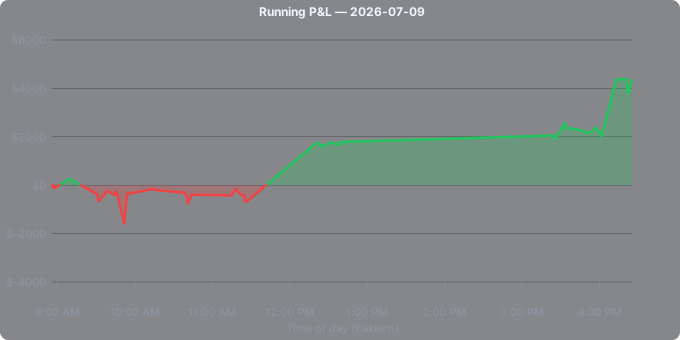
Session edge, AI coach verdict, and running P&L for 2026-07-09.
Trim Review
How much of today's result was carried by a few outliers? The table recomputes the core session stats with the biggest movers removed. Trimmed rows are colored vs baseline: green = holds most of the move, amber = meaningful erosion, red = collapses or flips sign.
| Scenario | Trades | Net P&L | Total R | E[R] / trade | $ WR | PF |
|---|---|---|---|---|---|---|
| Baseline (all trades) | 50 | +$4340.48 | +8.10R | +0.162R | 44.0% | 1.82 |
| − single best + single worst | 48 | +$3086.34 | +5.76R | +0.120R | 43.8% | 1.75 |
| − top 3 + bottom 3 (≈5% each tail) | 44 | +$732.54 | +1.37R | +0.031R | 43.2% | 1.25 |
Trimmed trades: Single best + single worst — removed SRXH +$2417.19 (best) · VRAX −$1163.05 (worst). Top 3 + bottom 3 — removed 3 from each tail (by $ P&L).
Top-heavy green session: most of the P&L came from a handful of outsized trades; the broader distribution was only modestly plus-EV. Real but concentrated edge.
Session verdict
The session's $4.34k net is almost entirely explained by two names. SRXH added $2.42k, JLHL produced a net of roughly $2.39k across three positions, and VRAX cost about $590 net across three of its own.
The remaining 44-plus positions — the bulk of the session's 50 trades — contributed approximately $120 combined. This is a day where the result was determined by a handful of positions while the rest of the activity was essentially flat.
VRAX was the drag, and the structure of what it offered makes clear why. The stock opened at $11.09 and made its high of $13.19 at 9:59am ET — an 18.9% move completed in the first 29 minutes of regular-session trading — then collapsed the rest of the day, closing at $6.36, down 42.7% from its own open.
The $644M in dollar volume on a 0.8M-share float means there was enormous participation, but virtually all of it was on the way down after 10am. Your first entry at 9:30am ET cost $638; at 9:51am and 9:53am you had two near-simultaneous positions that essentially offset each other ($1.21k gain against $1.16k loss), leaving you with a net negative on a name that offered the narrowest percentage move of any stock you touched today and had already made its high before the second position was entered.
SRXH is the cleaner story. It opened at $1.90, had a share-repurchase catalyst, halted once, generated $135.5M in dollar volume on a 21M float, and made a 71.1% move from open to its $3.25 high at 12:20pm ET.
Your entry at 12:10pm — ten minutes before the high — captured $2.42k at +4.51R. The stock retained 47% of that move, closing at $2.53, so this wasn't a case of selling into weakness; you were positioned while the move was still developing and the name was strong enough to hold meaningful ground afterward.
JLHL's data is incomplete — open and high are missing — but what is present is telling: a 1.5M-share float, $735.9M in dollar volume, and two halts, indicating far more range than the close of $12.79 alone conveys. Your net ~$2.39k from three positions skews heavily to the 4:08pm ET entry (+$2.35k, +4.38R), with an earlier 3:27pm position adding $613 and a 4:21pm position giving back $571.
The late entry that lost was the only meaningful friction on an otherwise well-read name. RPGL and RKTO were the two other runners today — you traded neither, and there was no reason to: RPGL peaked pre-market at 4:04am ET and retained -8% of its move, and RKTO peaked at 9:14am ET and retained -188%.
Both were already over before the regular session began.
The trailing seven days of runners reveal a consistent split by when the high occurs. Of roughly 15 names that made their intraday highs before 9:30am ET across the past week, all but one (FXHO, which retained 48%) closed holding under 25% of the open-to-high move — most retained deeply negative percentages, meaning they reversed through the open entirely.
Of the 9 names that made their highs after 11:00am ET, 8 retained 35% or more of the move, ranging from 37% up to 72%. The dividing line isn't float or dollar volume alone — it's when the high occurs.
VRAX, high at 9:59am ET, sits squarely in the early-fade group and behaved exactly as that pattern predicts (-225% retained). SRXH, high at 12:20pm ET, fits the afternoon-holder profile precisely.
Both of your traded names today were on the correct side of this split in terms of structure — the difference is that VRAX's high had already printed before your second and third entries, while SRXH's had not.