2026-06-09 · 7 min read
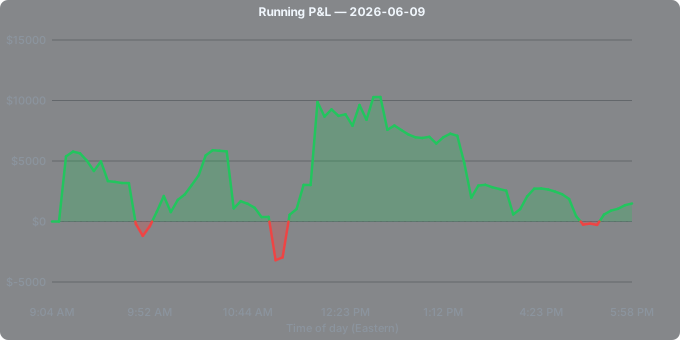
Session edge, AI coach verdict, and running P&L for 2026-06-09.
Trim Review
How much of today's result was carried by a few outliers? The table recomputes the core session stats with the biggest movers removed. Trimmed rows are colored vs baseline: green = holds most of the move, amber = meaningful erosion, red = collapses or flips sign.
| Scenario | Trades | Net P&L | Total R | E[R] / trade | $ WR | PF |
|---|---|---|---|---|---|---|
| Baseline (all trades) | 83 | +$1485.78 | +1.02R | +0.012R | 49.4% | 1.04 |
| − single best + single worst | 81 | −$660.37 | -0.45R | -0.006R | 49.4% | 0.98 |
| − top 5 + bottom 5 (≈5% each tail) | 73 | −$902.76 | -0.62R | -0.008R | 49.3% | 0.96 |
Trimmed trades: Single best + single worst — removed PAVS +$6854.53 (best) · DXST −$4708.38 (worst). Top 5 + bottom 5 — removed 5 from each tail (by $ P&L).
Outlier-carried green session: a single best trade (or the top 5%) is effectively the entire P&L. The rest of the book was roughly flat-to-red. Edge leaned on a few big pots more than the tape felt like it did.
Session verdict
Looking only at the tape of symbols, times, and price buckets, a neutral observer would predict a much bigger day than $1.49k because the +4.71R PAVS at 8:34am PT ($6.85k), +3.69R CCTG at 6:04am PT ($5.38k), and +2.42R PAVS at 8:07am PT ($3.52k) together put you around +$15.75k before dealing with any of the large losers. The three biggest losers — DXST at 7:33am PT (-3.23R, -$4.71k), MTEN at 8:04am PT (-2.46R, -$3.58k), and AZI at 6:45am PT (-2.32R, -$3.37k) — sum to roughly -$11.66k, which almost fully offsets those three high‑R winners and shows that risk on outlier losers between 6:45am and 8:04am PT was not constrained relative to the upside on your best trades.
All five PAVS material winners between 7:20am and 9:34am PT (from +1.13R/$1.65k to +4.71R/$6.85k) plus the later -1.96R/-$2.86k and -1.55R/-$2.25k PAVS at 10:23–10:24am PT mean that after banking about +$21.9k across the winners in that name, you then gave back $5.11k on late entries around 10:23–10:24am PT. The ELPW pair at 9:42–9:43am PT (+1.29R/$1.88k followed by -1.86R/-$2.71k) adds a similar same‑ticker giveback of $0.83k immediately after a working long in the $1–2 bucket.
In the 6:00am-7:30am PT block, you had 16 trades for $8.64k (P&L $4.96k at 6:00am-6:30am PT plus $3.68k at 7:00am-7:30am PT); that positive result despite AZI -$3.37k and DXST -$4.71k means the rest of the early book — anchored by CCTG +$5.38k and several smaller winners — more than offset two large hits. By contrast, the 8:30am-9:00am PT window’s 3 trades for $8.84k P&L at 66.7% WR line up with a concentrated push in PAVS that did not suffer a large offsetting loser in that half hour.
The price-bucket breakdown — $6.85k on the single $15–20 trade and $1.99k on two $10–15 trades versus -$2.04k across 31 trades in $3–5 and about -$3.41k across 15 trades in $1–3 — locates most of the drag in the crowded cheap names rather than in the higher-priced positions. The fact that 15 material trades (7 ≥ +1R and 8 ≤ −1R) out of 83 total produced only 0.012R E[R] shows that the session’s expectancy was flattened by allowing almost as many -1R to -3.23R outcomes as +1R to +4.71R outcomes on the trades that moved the needle.
Significance and conceptual math
With a breakeven dollar win rate of 48.4% derived from your $958.82 average win and -$900.62 average loss, today’s 49.4% WR clears that threshold by just 1.0pp, which explains why $1.49k on 83 trades is effectively a scratch in R terms at 0.012R E[R]. The profit factor of 1.04 versus your 90-day baseline PF of 1.41 means every dollar of loss today only earned you $1.04 instead of the usual $1.41, so realized reward per unit of loss ran about 26% lower than your baseline.
Day WR at 49.4% versus baseline 47.6% (z=0.329, p≈0.7419) is statistically indistinguishable, so the main difference versus baseline came from payoff sizes, not hit rate. The fact that 3 trades at ≥ +2R (PAVS +4.71R and +2.42R, CCTG +3.69R) coexisted with 3 trades worse than -2.3R (DXST -3.23R, MTEN -2.46R, AZI -2.32R) mechanically pulled today’s PF back toward 1.0 despite having clear outlier winners.
If you had capped those three big losers at exactly -1R each, you would have reduced realized losses by approximately (-3.23R+1R) + (-2.46R+1R) + (-2.32R+1R) = -4.01R, which at today’s $900.62 average loss scale translates to roughly $3.6k in saved P&L and a net closer to $5k instead of $1.49k. The price-bucket math is stark: the $15–20 bucket’s single PAVS trade accounts for $6.85k, the two $10–15 trades add $1.99k, and the 27 trades in $5–10 contribute $618.47, so about $9.46k of gross profit came from 30 higher-priced trades while 46 trades in $1–5 collectively lost about $5.45k.
Within that cheap universe, the $1–2 bucket’s 8 trades for -$1.73k at 12.5% WR and the $2–3 bucket’s 7 trades for -$1.68k at 42.9% WR show that 15 small-price positions generated over $3.4k of losses that never resembled the profile of your big winners. Time-of-day math reinforces it: the combined 6:00am-7:30am PT windows (7 trades at 6:00am-6:30am PT and 9 at 7:00am-7:30am PT) delivered $8.64k despite hosting AZI -$3.37k and DXST -$4.71k; removing just those two would leave that early block at roughly +$16.7k on 14 trades.
Similarly, the 8:30am-9:00am PT window’s $8.84k on 3 trades at 66.7% WR sits well above the session’s overall PF and WR, consistent with that narrow cluster around PAVS running at much higher expectancy than the day as a whole. When you compare today’s E[R] of 0.012R to your 90-day E[R] of 0.059R, you effectively captured about 20% of your typical per-trade expectancy, matching a day where a small set of -2R to -3.23R choices counterbalanced strong winners.
What you might have missed
Across 83 trades, 30 positions in the $5–20 range (1 in $15–20, 2 in $10–15, 27 in $5–10) produced about $9.46k of P&L, while 46 trades in the $1–5 buckets lost about $5.45k, so more than 100% of your net $1.49k came from the higher-priced slice even though you had more tickets in the cheap names. The single PAVS at $15–20 for +$6.85k and two trades in the $10–15 bucket for +$1.99k mean that 3 higher-price trades generated more dollar P&L than the other 80 positions combined.
Despite this, the 31 trades in the $3–5 bucket alone ended at -$2.04k and included MTEN -$3.58k and the two late PAVS cuts (-$2.86k and -$2.25k), so activity in the same nominal price zone as your successful CCTG and early PAVS actually flipped that zone negative. The 11:00am-11:30am PT and 11:30am-12:00pm PT windows quietly added $1.49k and $628.48 on just 3 trades at 100% WR, so the late session that often hosts fatigue instead showed clean execution, while the mid-morning cluster in cheaper names around 9:30am-10:30am PT contained several of the notable givebacks.
One thing to try next session
For the next session, cap yourself at 10 total trades in the $1–3 and $3–5 buckets combined and prohibit entering a new symbol in those buckets once realized P&L there reaches -$1.5k on the day. Applied to this tape, that kind of guardrail would have forced an earlier stop to the 46 trades in the $1–5 zone that ended at about -$5.45k, while leaving room to keep pressing the 30 higher-priced trades that produced roughly $9.46k, including the +4.71R PAVS at $15–20 and the +3.69R CCTG at $3–5.