2026-05-07 · 6 min read
Session edge, AI coach verdict, and running P&L for 2026-05-07.
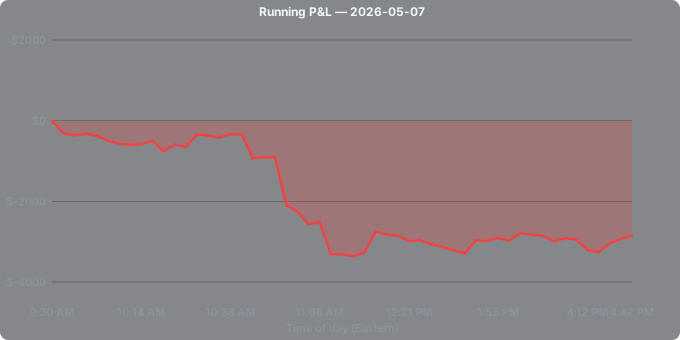
Session slice (heuristic read)
Trim Review
How much of today's result was carried by a few outliers? The table recomputes the core session stats with the biggest movers removed. Trimmed rows are colored vs baseline: green = holds most of the move, amber = meaningful erosion, red = collapses or flips sign.
| Scenario | Trades | Net P&L | Total R | E[R] / trade | $ WR | PF |
|---|---|---|---|---|---|---|
| Baseline (all trades) | 52 | −$2847.02 | -5.89R | -0.113R | 36.5% | 0.46 |
| − single best + single worst | 50 | −$2180.04 | -4.51R | -0.090R | 36.0% | 0.47 |
| − top 3 + bottom 3 (≈5% each tail) | 46 | −$1418.04 | -2.94R | -0.064R | 34.8% | 0.48 |
Trimmed trades: Single best + single worst — removed ATRA +$516.97 (best) · ATRA −$1183.95 (worst). Top 3 + bottom 3 — removed 3 from each tail (by $ P&L).
Broad-based red session: the loss is still there after trimming the biggest movers — this wasn't one bad trade, it was the whole book tilted the wrong way.
Session verdict
The highest-impact decision was allowing the same adverse pattern to generate four material trades, with the four prints at or above 1R all coming from one name and three of them on the loss side. The bigger backdrop is coherent deterioration, and today extends it rather than interrupting it: the 7d window is at -0.005R versus 0.050R in the prior-23d, with profit factor down to 0.97 from 1.22, and this session landed at -0.113R with PF 0.46.
Risk-wise this was a concentrated day, not a broad distribution of small independent mistakes; a few tail losses did most of the damage while the rest of the book was too weak to absorb them. The path also looks less like random chop and more like forcing after adverse movement, because the material damage clustered in a narrow span around 10:40am–11:30am PT and then required later winners to dig out of a deep hole.
The <30s losses do not bother me much here because those look compatible with deliberate exits; the real hazard sat in the 2-10 minute holds where heat was tolerated long enough to print three losses beyond 1R. If you replay the worst stretch at 3x size or 3 times in a week, this is the kind of shape that lengthens drawdown recovery materially because your average winner is smaller than your average loser.
So the main issue is not that the day was red; it is that tail exposure was allowed to bunch up faster than the book could realistically earn back.
Significance and conceptual math
The primary evidence is the short-horizon trend, and it is not subtle: versus the prior 23 days, the last 7 days show net P&L per session-day down by $1262.10, E[R] lower by 0.054R, profit factor lower by 0.25, and win rate only up 1.1 percentage points, which the pack correctly labels coherent deterioration. Today fits that pattern cleanly rather than wobbling away from it, because the session posted 36.5% wins, -0.113R, and PF 0.46, all worse than the already-soft 7d run rate.
The single-day win-rate contrast versus baseline, z = -1.242 and p about 0.2142, is only a rough check and it does not prove today was unusually bad on win rate alone. But win rate is only half the story here anyway, because your payoff ratio today was 0.80:1, meaning you needed about 55.5% wins just to break even and you only delivered 36.5%.
The 7d window tells a similar risk story: with avg win $232.96 versus avg loss $208.59, you need 47.2% wins, yet realized 46.5%, so even a near-coinflip hit rate is not enough when losses have widened versus the prior-23d. That widening matters: average loss grew from $143.63 in the prior-23d to $208.59 in the last 7 days, while average win only improved by $21.85, so the loss tail has been expanding faster than the upside.
Within this session, the four material trades are the right lens because they define the tail: one +1R winner against three losses beyond -1R means the extreme outcomes were negatively skewed, and that is exactly the shape that makes recovery slow. The time clustering around 10:40am PT to 11:09am PT also says these were not evenly scattered mistakes across 52 positions; exposure bunched up during one adverse pocket, which is a survival problem more than a forecasting problem.
On the toy sensitivity line, a 5 percentage-point lift in $ win rate would have moved this slice to $750.71 from -$2847.02, which shows the book is highly levered to modest execution improvement when tails are kept in check. Sample size is still only 5 session-days in the 7d window, so I would read the exact magnitudes loosely, but the direction of travel is clear: the recent issue is not lack of opportunity, it is that downside per mistake has become too expensive.
One thing to try next session
For the next session, impose a same-name tail brake: after the first loss of 1R or more in any symbol, no second entry in that name unless size is cut by at least 50% and the stop is hard-capped so the next loss cannot exceed 0.75R. This is a clean survival test because it targets concentration and drawdown convexity without asking you to trade less across the whole book.