2026-05-05 · 5 min read
Session edge, AI coach verdict, and running P&L for 2026-05-05.
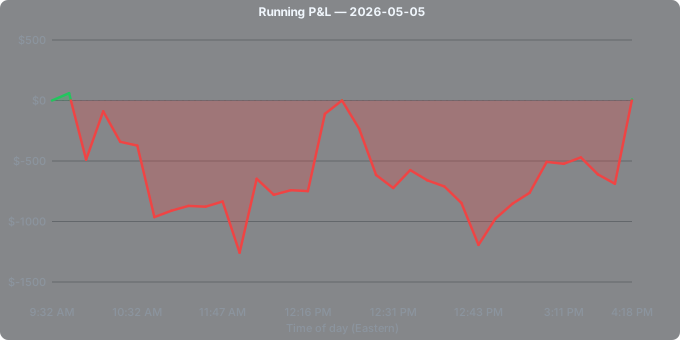
Session slice (heuristic read)
Trim Review
How much of today's result was carried by a few outliers? The table recomputes the core session stats with the biggest movers removed. Trimmed rows are colored vs baseline: green = holds most of the move, amber = meaningful erosion, red = collapses or flips sign.
| Scenario | Trades | Net P&L | Total R | E[R] / trade | $ WR | PF |
|---|---|---|---|---|---|---|
| Baseline (all trades) | 34 | +$7.98 | +0.02R | +0.000R | 47.1% | 1.00 |
| − single best + single worst | 32 | −$97.23 | -0.19R | -0.006R | 46.9% | 0.97 |
| − top 2 + bottom 2 (≈5% each tail) | 30 | −$186.88 | -0.36R | -0.012R | 46.7% | 0.92 |
Trimmed trades: Single best + single worst — removed AMD +$696.23 (best) · AIOS −$591.02 (worst). Top 2 + bottom 2 — removed 2 from each tail (by $ P&L).
Outlier-carried green session: a single best trade (or the top 5%) is effectively the entire P&L. The rest of the book was roughly flat-to-red. Edge leaned on a few big pots more than the tape felt like it did.
Session verdict
What would your equity curve have looked like if the late AMD winner never happened? The recent trend is mixed, not coherent: over the last 7 days versus the prior 23, win rate improved from 45.9% to 48.7% and net per day rose by $311.03, but E[R] only nudged from 0.052R to 0.054R and PF from 1.22 to 1.27, so today fits inside that mixed picture rather than extending a clean improvement.
From a risk-manager lens this was a one-print save, not a broadly controlled session: one +1.34R trade did most of the rescue work while the rest of the day was close to flat-to-fragile. The path looks whippy rather than smooth because the five material trades split 3 winners and 2 losers, and the losers were large enough that recovery depended on catching later clean moves rather than on many small edges compounding.
The main process issue is not raw aggression but tail concentration: your session-level result was basically balanced on whether a single afternoon winner showed up after earlier damage. Quick losses under 30 seconds can be perfectly valid stops, but having that many of them while needing one late outlier to square the book says your intraday risk was harder to recycle than the final net number suggests.
If you replayed the worst stretch three times without the AMD-type offset, this is the kind of day that can dig a real hole before your better setups get a chance to work.
Significance and conceptual math
The best evidence is still the short-horizon trend block, and it says mixed rather than clearly better or worse. Versus the prior 23-day window, the last 7 days show win rate up 2.7 points, E[R] up 0.003R, net dollars per session-day up $311.03, and profit factor up 0.04, which is improvement in outcome but only a slight lift in per-fill edge.
Today mostly wobbles around that picture instead of confirming it: the session win rate was 47.1%, close to the 7-day 48.7%, but E[R] was 0.000R and PF was 1.00, which says the edge per click was basically break-even today. The day-versus-baseline win-rate contrast backs that up only as a rough check, not a headline: 47.1% today versus 45.1% baseline with z = 0.223 and p about 0.8234 is nowhere near proof that today was meaningfully different.
Also, 34 positions today and only 5 session-days in the 7-day window mean you should read the short-run numbers as directionally useful, not as precision instruments. The breakeven math is more informative for a trader: with average winners of $223.49 and average losers of -$198.22, you needed about 47.0% wins today and you achieved 47.1%, so you cleared the bar by almost nothing.
Over the last 7 days, your average winner and loser imply a breakeven win rate of 42.8%, while realized win rate was 48.7%, so the recent week has had a real cushion even though today did not. That gap is the key distinction: the week has had some room for error, but this session had almost none, which is why the path risk mattered more than the closing number.
The 5-point win-rate bump line is $716.91 versus today’s $7.98, which tells you a small accuracy improvement would have had a big dollar effect because your win/loss size ratio is only modestly favorable and volume was decent.
One thing to try next session
For the next session, set a hard rule that after two sub-30-second losses in any rolling 30-minute block, you must cut size by one tier until you bank one full 30-60 second winner. That directly attacks the intraday stretch where fast stops can stack and make the session dependent on a later rescue trade.