2026-05-01 · 5 min read
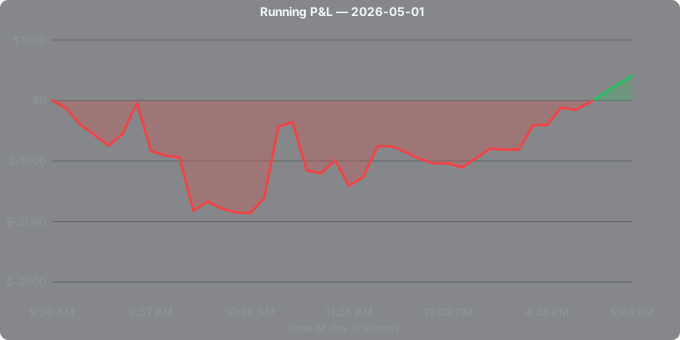
Session edge, AI coach verdict, and running P&L for 2026-05-01.
Session slice (heuristic read)
Trim Review
How much of today's result was carried by a few outliers? The table recomputes the core session stats with the biggest movers removed. Trimmed rows are colored vs baseline: green = holds most of the move, amber = meaningful erosion, red = collapses or flips sign.
| Scenario | Trades | Net P&L | Total R | E[R] / trade | $ WR | PF |
|---|---|---|---|---|---|---|
| Baseline (all trades) | 41 | +$409.52 | +0.84R | +0.020R | 48.8% | 1.09 |
| − single best + single worst | 39 | +$107.20 | +0.22R | +0.006R | 48.7% | 1.03 |
| − top 3 + bottom 3 (≈5% each tail) | 35 | +$683.03 | +1.39R | +0.040R | 48.6% | 1.35 |
Trimmed trades: Single best + single worst — removed AIOS +$1180.95 (best) · TLIH −$878.62 (worst). Top 3 + bottom 3 — removed 3 from each tail (by $ P&L).
Top-heavy green session: most of the P&L came from a handful of outsized trades; the broader distribution was only modestly plus-EV. Real but concentrated edge.
Session verdict
The numbers and the sequence mostly tell the same story: this session fits inside the recent mixed short-horizon tape rather than breaking it. The 7d versus prior-23d read is mixed, with $ win rate 45.6% versus 46.1% and E[R] 0.034R versus 0.046R, and today came in only slightly above baseline on the surface at 48.8% WR and 0.020R, so there is no clean expansion in edge here.
This was not a broad, healthy distribution; the day was defined by the 6 trades at or above 1R, with AIOS doing the lifting and TLIH doing most of the bleeding. What went well is obvious: AIOS printed the only 2R-plus winner and another +1R trade, PN also carried real P&L, and SNDK chipped in green.
What did not go well is concentration and repeat exposure: TLIH alone lost $1982.49 and produced three of the six material trades, while SOBR also bled, so a lot of your gross effort was spent digging out of one name-specific hole. The path was lumpy, not smooth; quick-stop damage in sub-30-second holds may be deliberate, but the repeated TLIH hits say this was not just routine defense, it was stubborn re-engagement into a weak patch.
Net positive on the blotter, yes, but the book quality was thin because one or two names determined whether the day existed at all.
Significance and conceptual math
Start with the 7d versus prior-23d evidence, because that is the cleaner short-horizon context: net $ per day is basically flat at $929.22 versus $925.40, $ win rate slipped by 0.5 points, E[R] slipped by 0.012R, and profit factor eased from 1.21 to 1.18. That is why the pack calls it a mixed signal, and today extends that mixed picture rather than clearing it up.
On the single session, the 48.8% win rate versus a 45.0% baseline is only a rough nudge, not proof of a better day; the printed z of 0.483 and p around 0.6288 say the contrast is weak, and same-session positions can lean on each other more than the math pretends. The more important point is economic, not cosmetic: today’s edge was tiny at 0.020R, which is above baseline 0.013R but still leaves very little room for slippage, commissions, or a couple of bad re-entries.
Your average winner was $240.13 and average loser was $209.19, so you only needed a 46.6% win rate to break even in dollar terms, and you did 48.8% today. That means the day was legitimately positive, but only by a narrow spread of 2.2 points above breakeven.
In the 7d window, the same math is sturdier: average win $228.04 versus average loss $162.36 means breakeven is 41.6%, while realized win rate is 45.6%, so the recent week still has cushion even though its quality has softened versus the prior-23d. That gap explains why a mediocre hit rate can still make money, but it also tells you where the danger sits: if losses get a little fatter from repeat stabs in the same name, the cushion disappears fast.
Today is a good example, because one heavy red symbol nearly canceled the good reads elsewhere. The exact 5-point $ win rate bump in the pack is worth $921.10 versus the actual $409.52, so a small lift in accuracy with the same payout profile would have added about $511.58.
One thing to try next session
Next session, cap yourself at two full-risk entries in the same symbol after the first material loss of 1R or more. If a name like TLIH tags that limit, any further participation has to be half-size only; that is a direct test of whether repeated re-engagement, not raw setup quality, is what is eating the book.