2026-04-27 · 5 min read
Session edge, AI coach verdict, and running P&L for 2026-04-27.
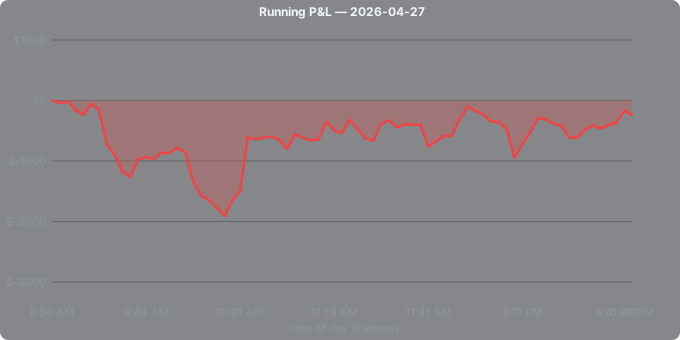
Session slice (heuristic read)
Trim Review
How much of today's result was carried by a few outliers? The table recomputes the core session stats with the biggest movers removed. Trimmed rows are colored vs baseline: green = holds most of the move, amber = meaningful erosion, red = collapses or flips sign.
| Scenario | Trades | Net P&L | Total R | E[R] / trade | $ WR | PF |
|---|---|---|---|---|---|---|
| Baseline (all trades) | 74 | −$241.58 | -0.53R | -0.007R | 41.9% | 0.95 |
| − single best + single worst | 72 | −$551.65 | -1.21R | -0.017R | 41.7% | 0.88 |
| − top 4 + bottom 4 (≈5% each tail) | 66 | −$116.77 | -0.26R | -0.004R | 40.9% | 0.97 |
Trimmed trades: Single best + single worst — removed HTCO +$887.81 (best) · ELPW −$577.74 (worst). Top 4 + bottom 4 — removed 4 from each tail (by $ P&L).
Broad-based red session: the loss is still there after trimming the biggest movers — this wasn't one bad trade, it was the whole book tilted the wrong way.
Session verdict
Reviewing this blind from the trade list alone, I would predict a day defined by one clean outsized winner, three real dents, and a lot of small churn that never built a cushion; the actual -$241.58 matches that shape. The bigger backdrop is not ambiguous: the last 7 days versus the prior 23 show coherent deterioration, with win rate down from 48.6% to 41.9% and E[R] down from 0.079R to -0.032R, and today extends that pattern rather than breaking it.
This was not a broad-distribution loss where weakness was everywhere in equal measure; one +1.95R print in the morning kept the book from looking worse, while the rest of the session leaked through many small decisions. The bookends were not the main story in a helpful sense: the first 30 minutes are absent from the positive time windows, and the late edge was too narrow to repair earlier damage, with the middle carrying both the best rescue and the ugliest concentration.
The path reads whipsaw, not smooth: fast-stop inventory under 60 seconds lost heavily, while the 1-2 minute lane did the earning, which suggests the issue was less idea generation than forcing immediacy on names that did not pay for it. With 74 positions, the loss was not caused by one catastrophic lapse, but fees, friction, and repeated sub-breakeven outcomes likely taxed every marginal click.
The accounting conclusion is that selectivity and intraday pacing, not raw opportunity, were the missing controls.
Significance and conceptual math
The primary evidence is the recent trend, and it is ugly in a coordinated way: over the last 7 days versus the prior 23, net P&L per day fell by $2740.41, win rate fell 6.7 percentage points from 48.6% to 41.9%, E[R] dropped 0.112R from 0.079R to -0.032R, and profit factor slid from 1.49 to 0.84. When all four move down together, that is not noise you dismiss first and ask questions later; it is a short-horizon deterioration that deserves to be named.
Today fits that trend almost exactly: same 41.9% win rate as the 7d window, PF at 0.95 which is a bit better than the 7d 0.84 but still below 1, and E[R] at -0.007R which is less bad than the 7d average without actually turning positive. The single-day win-rate contrast versus baseline, z = -0.585 with p about 0.5584, says today by itself does not prove a special break from the longer history; it mostly agrees with the weaker 7d tape rather than adding a new signal.
Sample size matters in one place: the 7d window is only 5 session-days, so I would trust the direction more than the exact decimals. The cost structure of the book is doing you no favors right now.
Today your average winner was $161.98 and your average loser was $122.39, so you needed a 43.0% win rate just to break even and you printed 41.9%, which is why a respectable 1.32:1 payoff ratio still left you red. Over the last 7 days the same math is harsher: with $209.44 average wins against $181.06 average losses, you need 46.4% wins and you have only been delivering 41.9%, so even decent payoff per winner cannot outrun the frequency deficit.
Put differently, the recent slump is not just fewer winners; losses have gotten expensive enough that your required hit rate rose by 7.6 points versus the prior 23 days, from 38.8% to 46.4%. The practical value of fixing this is not small: the pack’s exact +5 percentage-point $ win-rate bump is worth $1052.17 for this session instead of -$241.58, using today’s own average win and loss sizes.
One thing to try next session
For the next session, impose a hard rule around the bookends: in the first 30 minutes and the final 30 minutes, cap yourself at one starter and one add per idea, and do not take any re-entry unless the first attempt made at least 0.5R unrealized before stopping out. That specifically tests whether your edge is really in the middle while cutting the high-friction clicks that are most likely turning the open and close into leak zones.