2026-04-21 · 5 min read
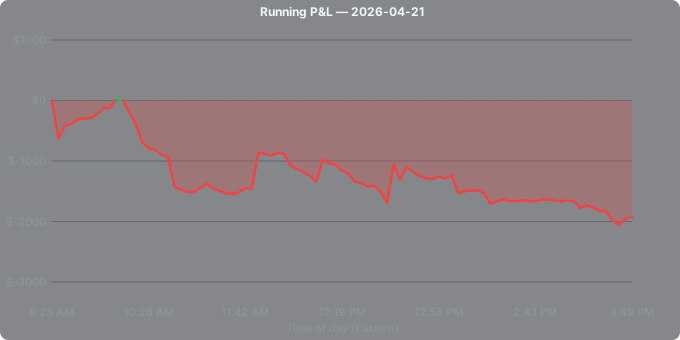
Session edge, AI coach verdict, and running P&L for 2026-04-21.
Session slice (heuristic read)
Trim Review
How much of today's result was carried by a few outliers? The table recomputes the core session stats with the biggest movers removed. Trimmed rows are colored vs baseline: green = holds most of the move, amber = meaningful erosion, red = collapses or flips sign.
| Scenario | Trades | Net P&L | Total R | E[R] / trade | $ WR | PF |
|---|---|---|---|---|---|---|
| Baseline (all trades) | 90 | −$1921.38 | -3.53R | -0.039R | 36.7% | 0.63 |
| − single best + single worst | 88 | −$1927.19 | -3.54R | -0.040R | 36.4% | 0.57 |
| − top 5 + bottom 5 (≈5% each tail) | 80 | −$1965.73 | -3.61R | -0.045R | 35.0% | 0.38 |
Trimmed trades: Single best + single worst — removed FFAI +$634.55 (best) · XRTX −$628.74 (worst). Top 5 + bottom 5 — removed 5 from each tail (by $ P&L).
Broad-based red session: the loss is still there after trimming the biggest movers — this wasn't one bad trade, it was the whole book tilted the wrong way.
Session verdict
What surprised me most is how hard today broke a genuinely improving short-horizon trend: the last 7 days were running at 49.1% win rate and 0.193R per fill versus 46.0% and 0.010R in the prior 23 days, and this session came in at 36.7% and -0.039R. That makes today a break, not an extension, of the recent regime, and the shape matters: this was not one catastrophic print masquerading as a bad day.
The authoritative count is 3 material trades, and they were nearly balanced in dollars, so the real damage came from the other 87 fills leaking steadily enough to turn two +1R winners into a -$1.9k session. Path-wise this reads more grind than whipsaw: a few profitable pockets existed, but the book could not retain them because loss frequency stayed too high relative to a reward:risk profile that is only 1.08:1.
For the recent trajectory to be sustainable, you need the 7-day edge to keep showing up as either materially larger winners than losers or a win rate near 50%; today had neither. The fragile assumption is that the recent jump in average winner size can survive a high-turnover, 90-position day without the book reverting to sub-breakeven hit rate.
Significance and conceptual math
The main evidence is still the recent trend, and it had been strong: versus the prior 23 days, the 7-day window improved by +3.1 percentage points in win rate, +0.183R in E[R], +$4022.86 in net per session-day, and +0.83 in profit factor, with the pack calling that Coherent improvement. Today did not confirm that trend; it wobbled against it on every key line, posting 36.7% wins, -0.039R, and 0.63 profit factor.
The single-day win-rate contrast versus baseline, z = -1.658 and p ≈ 0.0973, is a rough baseline check and points the same direction as the P&L: weaker than usual, though not enough to hang the whole story on one day’s hit rate alone. The more useful math is breakeven math.
With average winners of $97.10 and average losers of $89.92, this book needed about 48.1% wins just to tread water, and it delivered 36.7%, so the loss is not mysterious. In the 7-day window, the economics were much healthier: average win $341.75 versus average loss $176.22 means you only needed 34.0% wins, while realized win rate was 49.1%, which is why that stretch printed so well.
So for the current trajectory to be sustainable, one of two things must stay true: either winner size remains dramatically above loser size like the recent 7-day profile, or win rate has to climb back toward the high-40s. Today’s mix violated both conditions at once.
Also note the 7-day window is only 5 session-days, so the trend is real enough to name but still vulnerable if more sessions look like this one. The exact 5-point lift in $ win rate would have been worth $841.58 today, which tells you this session was close enough to salvage with modestly better conversion, but not close enough to excuse the underlying leakage.
What you might have missed
The non-obvious part is that the day was not ruined by the three material trades; they almost netted out, with two +1R winners offsetting one -1R loser. Said differently, the obvious culprits are too small to explain a -$1.9k outcome.
The hidden problem was the ordinary flow: dozens of sub-1R decisions, especially short holds, combined into a loss large enough to swamp the headline prints.
One thing to try next session
Next session, impose a hard audit trigger after every 25 fills: if your running $ win rate is still below the session breakeven line of 48.1%, cut new entries in half until it recovers. That directly tests whether the recent edge is actually broad enough to survive 90-fill pace, or whether size and frequency are just magnifying small negative expectancy when conversion slips.